Herault, Charles-Antoine|Coypel, Noel; A Landscape with the Flight into Egypt; National Trust, Tatton Park; http://www.artuk.org/artworks/a-landscape-with-the-flight-into-egypt-131315
If your Christmas is not merry and bright, if it’s blue instead of red, or if it’s lonely instead of a joyful family; just know that it’s absolutely fine. There’s nothing wrong with you or with your Christmas.
The birth of Jesus Christ had nothing to do with such things in the world that He was born and lived in. Instead, the Scriptures show us it was stark and bleak, though not without a ray of hope. Even after the birth, Jesus and his folks had to deal with constant dangers and foreboding, as a refugee family on the run, crossing risky borders while authorities demanded papers and they had none to show.
The Bible talks about a Jesus who comes into the world of violence, fear, misery, poverty, colonization, and injustice. It is in this world that He came naked, homeless, and as one for whom there was no room in anyone’s house or heart. Jesus’ early life was lived as a vulnerable refugee in Egypt at the mercy of strangers who took his family in and provided for them during their sojourn there. Therefore, Jesus Christ can come to you today in your own vulnerabilities and needs and in your lonely space of a godforsaken mess. It was made possible not because of the manger or the cradle but through His cross. May we run to the Cross and find forgiveness, love, mercy, and comfort in whatever situation you find yourself in this Christmas in 2022 on in the new year.
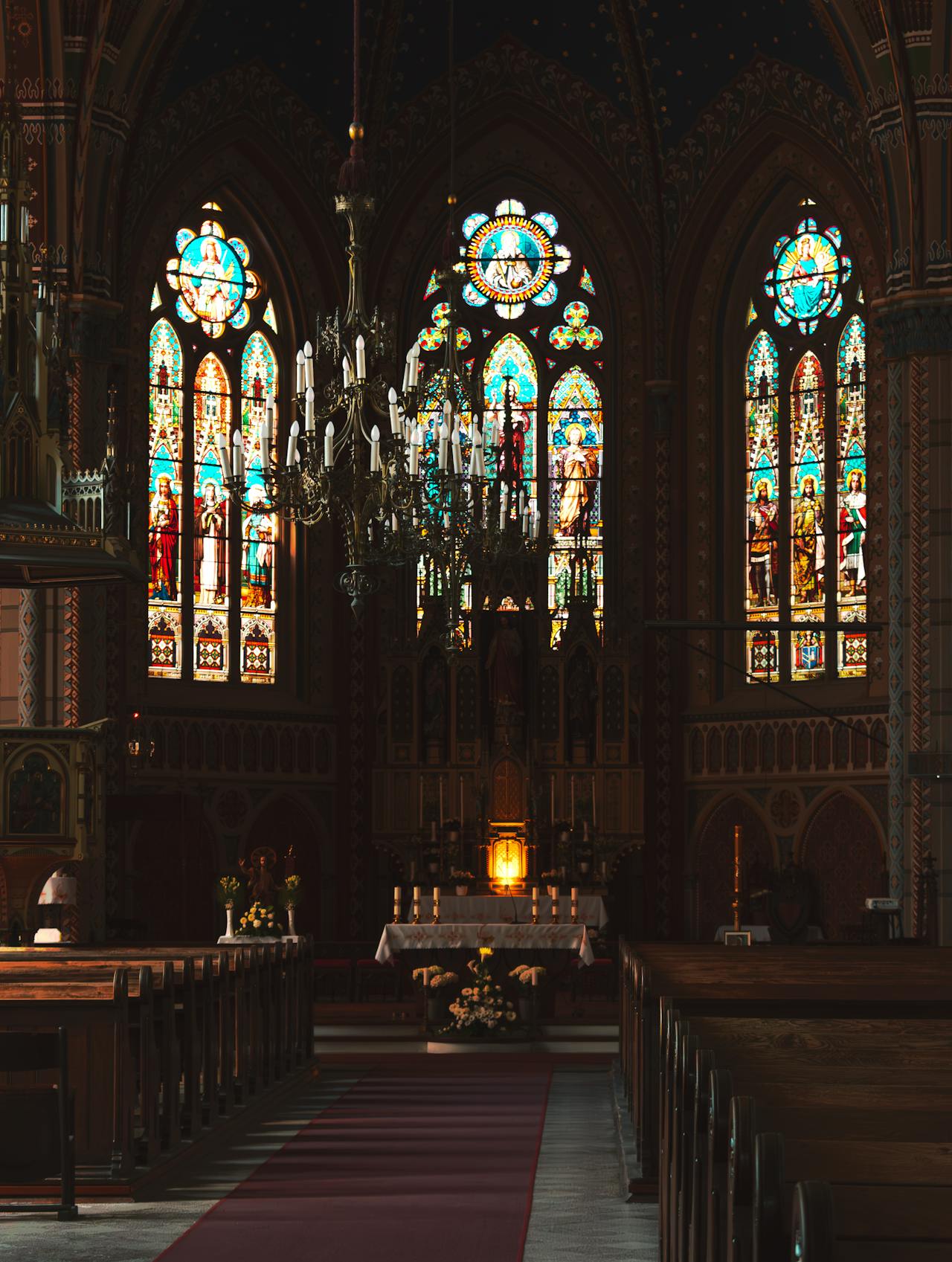
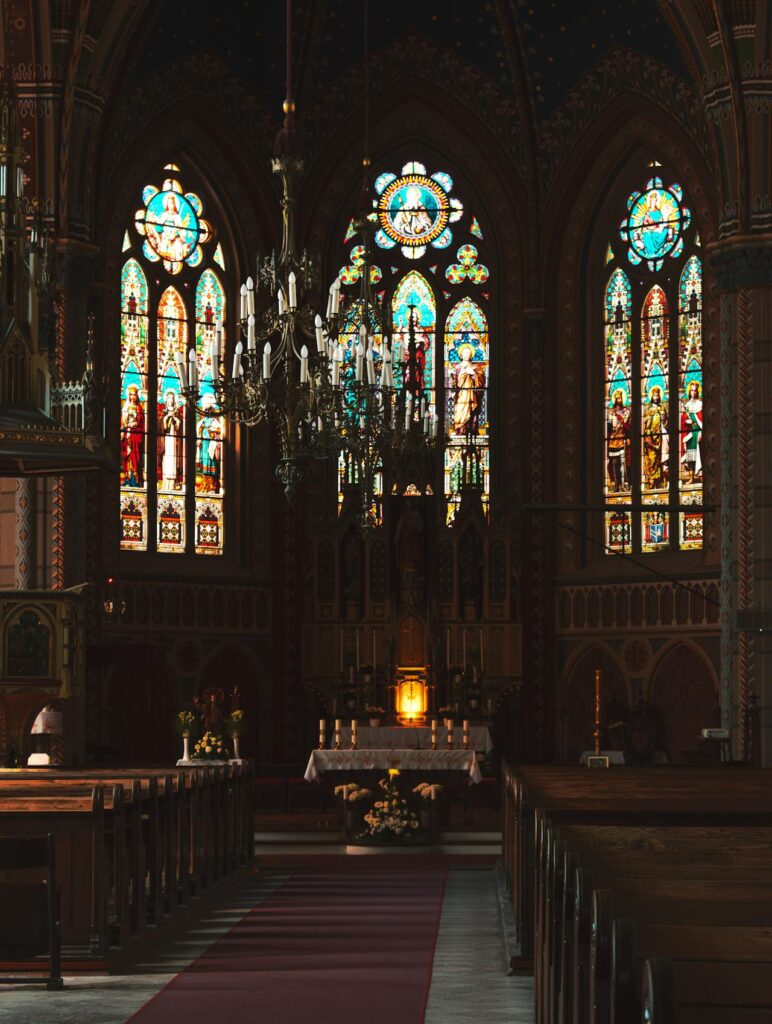
(Photo by Sándor Skoda from Pexels: https://www.pexels.com/photo/stunning-gothic-cathedral-interior-with-stained-glass-33419138/)
The word that keeps resurfacing as I reflect on the state of contemporary Christianity is shades. To me, it feels like a paint store with too many shades and not enough windows. Visit a few churches, browse denominational websites, or scan the congregations of any modern city, and the pattern becomes unmistakable. Christianity has splintered into hues — theological, liturgical, cultural, political, — that were originally meant to function as windows through which the light of Christ shines. Too often, however, those windows have hardened into opaque walls.
Many Christians have been trained to introduce themselves by their label first: Baptist. Anglican. Pentecostal. Reformed. Lutheran. Catholic. The label precedes the confession.
But what if that order is precisely the problem?
Baptism as a Transfer of Citizenship
Ask a Christian what happened at their baptism, and the answers frequently orbit around a local congregation, a pastor, or a denominational tradition. These answers are not entirely wrong — but they are incomplete in a way that matters enormously.
The Apostle Paul speaks of baptism in far more expansive terms:
“For as many of you as were baptized into Christ have put on Christ” (Galatians 3:27, ESV).
Baptism does not merely induct believers into an ecclesial structure. It unites them to a Person. And in being joined to Christ, believers are simultaneously joined to all who belong to Him — across time and place and every cultural expression of the faith.
Baptism is not a club membership. It is a transfer of citizenship. Emerging from the waters, the Christian does not join a franchise but enters a kingdom. We become part of the Corpus Christi, the Body of Christ, i.e., a communion that transcends geography, ethnicity, language, century, and skin tones. Baptism is less a membership card and more a passport into a reality far older and wider than any single tradition can contain.
The Problem of Tribal Christianity
Yet Christians rarely live as citizens of that kingdom. Too often, congregations and denominations become the entire horizon of Christian identity. Those outside one’s theological “shade” are treated not as fellow heirs of grace, but as strangers, rivals, or competitors for doctrinal legitimacy.
I’m not arguing against rootedness. Root matter as C.S. Lewis, in Mere Christianity, famously described Christianity as a great hall with many rooms branching from it. The hall represents the core of the faith, while the rooms symbolize the particular traditions in which believers worship, pray, and serve. Lewis rightly observed that one cannot permanently live in the hallway; one needs a room — a concrete community and a spiritual home.¹
Yet there is a profound difference between inhabiting a room and mistaking the room for the whole house. When denominational identity becomes primary, Christians confuse the filter for the light itself. The color of the stained glass begins to eclipse the sun shining through it.
What the Early Church Knew
The early church understood this with far greater clarity than many modern Christians do.
On his way to martyrdom in the early second century, Ignatius of Antioch wrote plainly:
“Wherever Jesus Christ is, there is the Catholic Church.”²
Ignatius was not speaking of a narrowly institutional structure in the modern sense. His concern was the universal presence of Christ among His people, a reality that could not be confined to a nation, a city, a bishop, an ethnicity, or a liturgical style.
Similarly, Cyril of Jerusalem instructed fourth-century catechumens that the term catholic meant “universal”— a church spread throughout the whole world, embracing every kind of person.³ Baptism united believers not merely to a local assembly, but to this worldwide communion of saints stretching backward and forward through time.
The early church inherited something immense and majestic. Over the centuries, that magnificent inheritance was too often reduced to brands, tribes, skin tones, style of worship, and competing subcultures.
Unity Without Relativism
Before anyone accuses this of being a warm bath of theological mush — let me be clear. This is not a call to believe anything, as long as we use the word ‘Jesus’ and smile at each other. The Body of Christ is held together by what the church has historically called the depositum fidei — the deposit of faith handed down from the apostles. The Trinity. The Incarnation. The atoning death and bodily resurrection of Jesus Christ. Salvation by grace through faith. These are not the “shades” Christians quarrel over; they are the white light that makes every legitimate shade possible. They constitute the grammar of Christian faith itself, and without them, the language becomes confusing. Church historian Jaroslav Pelikan captured it best:
“Tradition is the living faith of the dead; traditionalism is the dead faith of the living.”⁴
True catholicity preserves the apostolic faith with living hands. It allows the faith to breathe afresh in every generation rather than embalming it in rigid tribalism or denominational nostalgia. As St. Vincent of Lérins said, the test of genuine Christian unity is never doctrinal minimalism — it is fidelity to what has been believed everywhere, always, and by all.
Learning to See the Whole Body
Recovering this vision requires a fundamentally different posture toward fellow Christians.
It requires believers to stop guarding their shades and start recognizing the Body. When encountering a Christian from another tradition — a Coptic believer in Egypt, a Brazilian Pentecostal, a Benedictine monk, an Orthodox priest, a silent Quaker — the first instinct should not be to catalogue differences, but to recognize someone marked by the same baptism and claimed by the same Lord.
Such recognition requires real humility: the humility to learn from traditions one does not fully understand, and the courage to stand beside Christians who differ on secondary matters while remaining united in Christ.
In the words of Dietrich Bonhoeffer, “Christian community is not an ideal which we must realize; it is rather a reality created by God in Christ in which we may participate.”⁵
Christian community exists through Jesus Christ and in Jesus Christ. If He remains at the center, the church remains truly the Body. If He is displaced by our ideology, tribalism, or cultural preference, the community becomes something else, whatever Christian vocabulary it continues to use.
The Table Already Set
I keep coming back to the image of a table. Not a table divided by denominational seating charts — Baptists here, Catholics there, Pentecostals in the corner, Orthodox at another end — but a table where the decisive question is not denominational affiliation, but whether one bows before the crucified and risen Christ.
My baptism was not a ticket into a religious club. It was an invitation to that table — a feast already prepared and already populated by saints across centuries, languages, and traditions. The tragedy is how often Christians argue about the seating arrangements instead of rejoicing in the meal itself.
We were not baptized into a denomination. We were baptized into a Person.
His Body is larger, older, and more glorious than the imagination of any tradition. The cord that binds Christians together is not identical liturgy, shared political alignment, or uniformity on every secondary doctrine. It is the unbreakable confession that Jesus Christ is Lord — crucified, risen, reigning, and returning. That cord is strong enough. That cord has held martyrs and mystics, reformers and contemplatives, house churches in Asia and Iran and ancient liturgies in Ethiopia. It’ll hold us too, if we stop trying to braid something smaller over it.
Where have you seen the ‘white light’ shine through a different ‘stained glass’ window? Tell us below.
References
Lewis, C.S. Mere Christianity. New York: HarperOne, 2001, Preface.
Ignatius of Antioch. Letter to the Smyrnaeans 8:2.
Cyril of Jerusalem. Catechetical Lectures XVIII.23.
Pelikan, Jaroslav. The Vindication of Tradition. New Haven: Yale University Press, 1984.
Bonhoeffer, Dietrich. Life Together. New York: Harper & Row, 1954.
I’ll be honest with you: I used to be obsessed with going back.
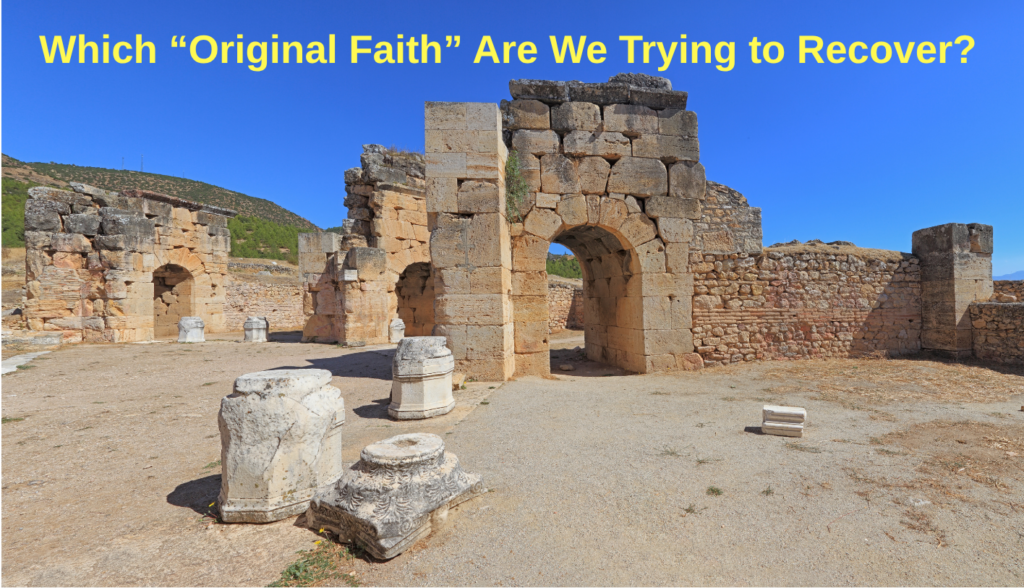
Back to the apostles. Back to the early fathers. Back to some imagined “pure” moment when the faith was untouched by the messiness of culture and time. I suspect I’m not alone. It’s this quiet anxiety that plagues so many serious Christians today: this desperate longing for a theological photograph that is clear, complete, and frozen.
But the longer I’ve walked with Scripture and history, the more convinced I am that that photograph never existed.
Trying to restore it, however well-intentioned, is built on a myth.
Christian tradition has never been a still image. It’s a living story — carried forward by the Spirit, shaped by centuries of messy encounters, and currently unfolding. To treat the past as a destination isn’t faithfulness.
The Foundation Is Real — But It’s Not the Whole House
The apostolic foundation is non-negotiable. The creeds, the canon, the sacraments — they anchor us to the life, death, and resurrection of Jesus. The councils of Nicaea (325 AD) and Chalcedon (451 AD) were decisive.¹ The creeds are guardrails for our faith.
But here’s where we trip up: we confuse the foundation with the building.
No architect mistakes the slab for the house. The patristic era gave us the foundation. The Spirit has been building ever since.
Pelikan captured it precisely: *”Tradition is the living faith of the dead; traditionalism is the dead faith of the living.”*² Tradition breathes. It grows. It has never — not once in two thousand years — stopped moving.
The Gospel Moves by Meeting People, Not Copying Them
From the beginning, the pattern has been the same: the Gospel walks into a new world, and both the Gospel’s expression and that world change.
When Christianity moved from Jewish Palestine into the Greco-Roman world, Justin Martyr and Origen didn’t just translate words. They engaged Greek philosophy head-on, showing how the Logos of John’s Gospel actually answered the deep, aching questions of the philosophers.³ That wasn’t compromise. That was faithful interpretation taking a new context seriously.
When the Gospel hit North Africa, it birthed Augustine — arguably the most influential theologian in Western Christianity. But his thoughts on grace, sin, and time weren’t formed in a sterile lab. They were forged in his African context, his restless heart, and a spiritual journey that gave us one of the most honest autobiographies ever written.⁴ The Spirit works through the particular — through one man’s specific scars — to create something universal.
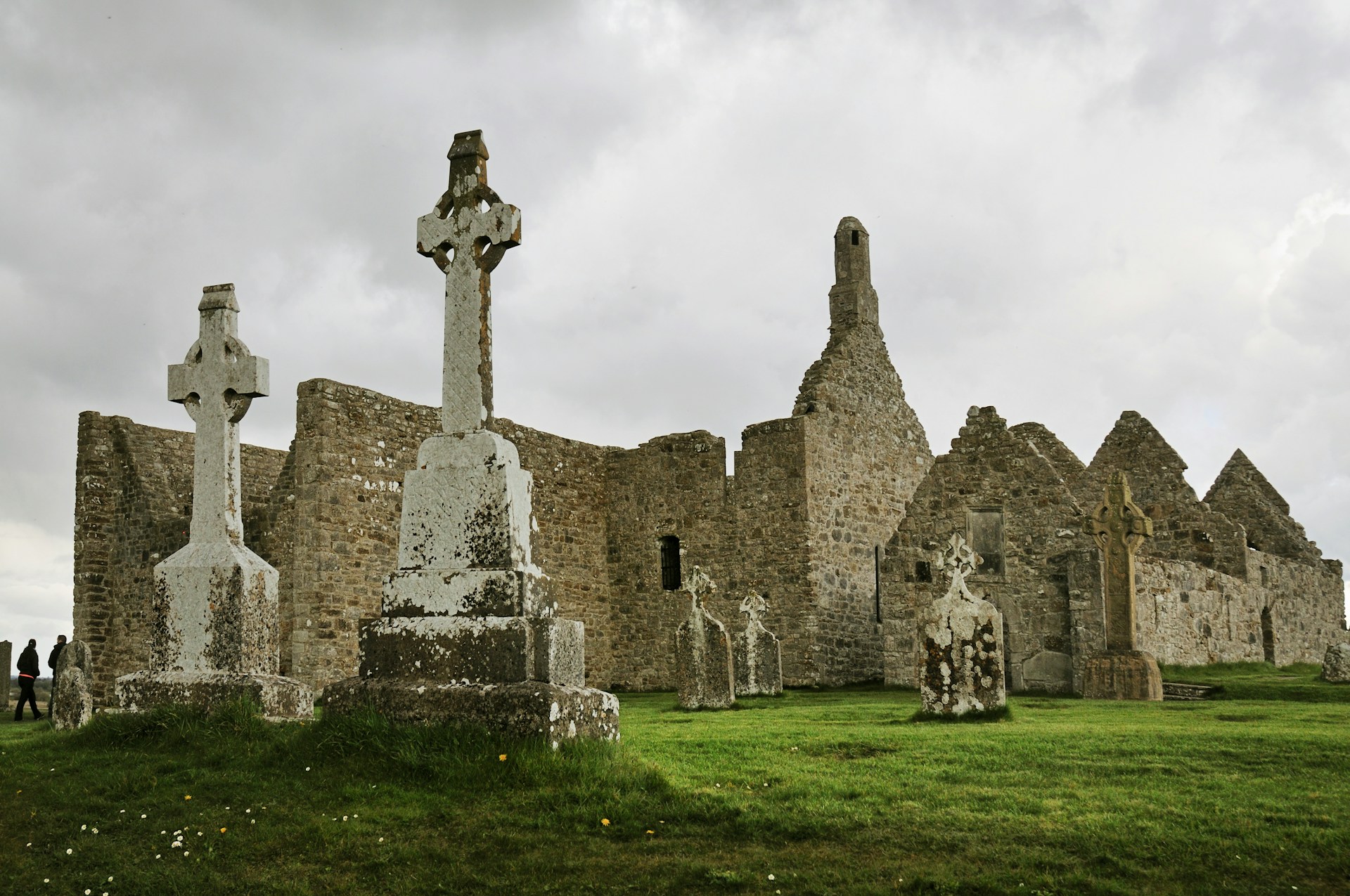
And when the faith reached the Celtic world, it developed a spirituality of creation, pilgrimage, and holy wandering that looked nothing like Roman Christianity.⁵ Different accent but the same Gospel.
From Wittenberg to Azusa to Lagos
The Reformation was another such encounter. Luther, Calvin, and the Anabaptists were not discarding tradition — they were excavating dimensions of the apostolic witness buried under centuries of institutional weight.⁶ They gave us the priesthood of all believers: the radical insistence that every ordinary person stands before God without needing a human middleman.
Then came Azusa Street. 1906. Los Angeles. Among the poorest and most marginalized people in the city, the Pentecostal movement erupted — a spirituality of immediacy, insisting that the Spirit’s power wasn’t a relic of the apostolic age but a present, available reality.⁷ Today, Pentecostalism is the fastest-growing expression of Christianity on earth. The Spirit, it turns out, didn’t ask for our permission.
And now? The biggest shift isn’t happening in Europe or North America. It’s happening in Africa, Latin America, and Asia. As numerous scholars of World Christianity are documenting for the church to see: the Global South isn’t just receiving Christianity, rather it’s reshaping it.⁸
African theologians like John Mbiti have argued that indigenous understandings of God didn’t need to be bulldozed for the Gospel to take root. They prepared the ground for it, just as Greek philosophy did in the ancient world.⁹ These voices read the Beatitudes not as pretty poetry for the comfortable, but as words spoken directly to the genuinely poor. They read the Psalms of lament not as metaphor but as the cries they hear in their own neighborhoods. In doing so, they’re returning something to the whole church — a dimension of Scripture that Western Christianity, in its relative comfort, had quietly set aside.
This isn’t theological relativism. It’s the Spirit doing exactly what the Spirit has always done.
A Living Flame, Not a Museum Piece
Yves Congar described tradition as a living transmission — not a preserved specimen in a jar, but a living flame passed from hand to hand across the centuries.¹⁰ The flame is the same, every hand holding it is different.
That image is both freeing and terrifying.
It’s freeing because we aren’t responsible for running a museum. But it’s terrifying because we are responsible for carrying that flame faithfully — discerning what is a genuine encounter with the Spirit and what is simply the culture co-opting the Gospel for its own ends.
That discernment is hard. It is the hardest thing the church is ever asked to do. History is littered with moments where the church mistook its own cultural preferences for the Spirit’s movement — and just as many where it mistook rigidity for faithfulness. Both errors hurt. We won’t always get it right. But refusing to engage isn’t neutrality; it’s quitting.
What This Actually Asks of Us
It’s uncomfortable to admit that our understanding of God is still growing. It takes a humility that doesn’t come naturally to people who love certainty to accept that we aren’t the final chapter. We’re participants in the next one.
The question for our generation isn’t just, “What did the early church believe?” That question is necessary. But it’s not enough.
The real question is: How is the Gospel encountering our world right now — and what part of its inexhaustible truth is being revealed through that encounter?
Every generation that asked this honestly found something.
Jerusalem taught us Jesus fulfills Israel’s story. Athens taught us He is the ground of all reason. Africa gave us Augustine’s depth of grace. The Reformation gave us the priesthood of every believer. The Global South is teaching us — right now, if we’re listening — to read Scripture from below, from the margins, from the place of need, not power.
This is the tradition we have received. This is the tradition we are called to carry forward. Not as museum curators dusting off old artifacts, but as faithful witnesses.
Where do you see the Spirit speaking a “new accent” in your own context today? Is there a cultural encounter your community hasn’t fully taken seriously yet? I’d love to hear your thoughts in the comments.
Notes & References
¹ For an authoritative treatment of the early councils and their doctrinal significance, see Pelikan, Jaroslav. The Christian Tradition: A History of the Development of Doctrine, Vol. 1: The Emergence of the Catholic Tradition (100–600). University of Chicago Press, 1971.
² Pelikan, Jaroslav. The Vindication of Tradition. Yale University Press, 1984, p. 65.
³ Gonzalez, Justo L. The Story of Christianity, Vol. 1: The Early Church to the Dawn of the Reformation. HarperOne, 2010, pp. 52–68.
⁴ Brown, Peter. Augustine of Hippo: A Biography. Revised Edition. University of California Press, 2000. See also Augustine. Confessions. Translated by Henry Chadwick. Oxford University Press, 1991.
⁵ Cahill, Thomas. How the Irish Saved Civilization. Anchor Books, 1995, pp. 148–179.
⁶ McGrath, Alister E. Christianity’s Dangerous Idea: The Protestant Revolution. HarperOne, 2007, pp. 1–22.
⁷ Synan, Vinson. The Holiness-Pentecostal Tradition: Charismatic Movements in the Twentieth Century. Eerdmans, 1997.
⁸ For a succinct history of this discipline and latest reference list, see Kim, Kirsteen. “What Does World Christianity Mean for Mission Studies? Explorations in Christianity Worldwide.” International Bulletin of Mission Research 49, no. 4 (2025): 280-296. https://doi.org/10.1177/23969393251359837
Jenkins, Philip. The Next Christendom: The Coming of Global Christianity. Oxford University Press, 2002, pp. 1–14.
⁹ Mbiti, John S. African Religions and Philosophy. Heinemann, 1969. See also Mbiti, John S. Bible and Theology in African Christianity. Oxford University Press, 1986.
¹⁰ Congar, Yves. Tradition and Traditions: An Historical and a Theological Essay. Macmillan, 1967.
Vinod John writes at the intersection of theology, history, and lived faith. You can follow along at his website on on Medium/Substack
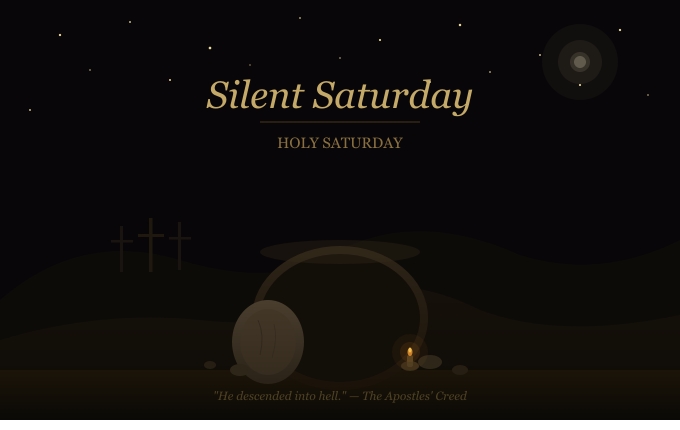
Today marks the final day of the Lenten journey — Holy Saturday, often called Silent Saturday — a day of rest and preparation for the Resurrection. And yet, for all its weight, nobody quite knows what to do with it.
Good Friday has its gravity—the cross, the darkness, the cry of dereliction. Easter has its trumpets. But the day in between just sits there, quiet and strange. The altars are bare. There is no Eucharist, no alleluias. In the old liturgical rhythm, not even a candle is lit. It is the one day of the Church year when the world is simply asked to wait—and waiting, as most of us know, is its own kind of suffering.
Jesus’ disciples certainly found it so. They scattered. They hid. Whatever they had hoped Jesus was, it seemed finished.
But the oldest Christian confession dares to say otherwise. The Apostles’ Creed, in its spare and careful language, declares that after His death, Christ “descended into hell.” Certain Christians anchor this in specific texts, such as, 1 Peter 3:18–20, Ephesians 4:8–9, Acts 2:27, and Matthew 12:40.
However, the original Latin word is inferos, meaning the realm of the dead. The Greek and Hebrew terms, Hades and Sheol, also mean the common realm where human souls go when they leave the body. Therefore, in the Creed, “hell” is not the place of final punishment, but the realm of the dead—the place every human goes. Christ went there because He went everywhere humans go. Jesus did not sidestep death or hover above it. He entered it—all the way in, just as He entered everything else about our condition.
What happened there is where different Christian traditions diverge—and they do so honestly. Eastern Orthodox have long treasured an icon of Christ standing on the splintered gates of Hades, reaching down to pull Adam and Eve out of the dark—a picture of Easter that begins before the stone ever rolls away. Medieval theologians spoke of the righteous dead, the patriarchs and prophets, finally receiving what they had only seen from a distance. Calvin argued the “descent” was not a journey at all but the depth of spiritual suffering Christ endured on the cross—the hell He absorbed so we would not have to bear it. Still other scholars read 1 Peter 3 as Christ declaring His victory to fallen spiritual powers — a proclamation not of mercy but of conquest.
The honest answer is that Scripture leaves this in partial shadow. And perhaps that is fitting. Holy Saturday is, by its nature, the day we cannot fully see into.
What we can say is this: the silence was not emptiness. Wherever Christ was on that Saturday, He was not a victim waiting to be rescued. He was moving through death with the same intention He brought to everything—purposeful, sovereign, undefeated even in the grave.
That matters for more than theology. Most of us know what it is to live in a Saturday season—after something has broken, before anything has been restored. The prayer that hasn’t been answered. The diagnosis that changed everything. The relationship that ended without resolution. The long, grinding wait when Friday’s wound is still fresh and Sunday feels like a rumor.
Holy/ Silent Saturday does not offer cheap comfort. It does not rush you toward the resurrection or tell you to cheer up. What it offers is something stranger—and more solid—than that: the assurance that Christ has already been into the darkest place you’re facing. He didn’t send a message from outside it. He went in. He holds, as He told John, the keys of death and Hades. He didn’t borrow them. He took them.
So, sit in the stillness today if you need to. Name the things that feel sealed and cold. And remember—the silence outside the tomb was not the silence of a story ending. It was the silence before a door flew open from the inside. He is already there. The stone will move.
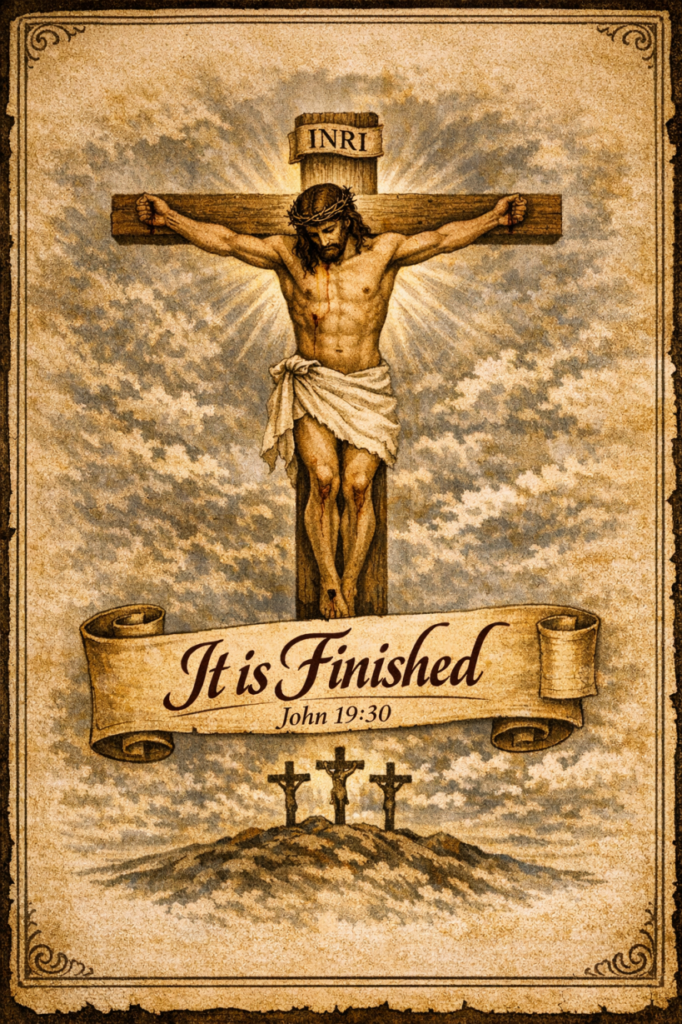
On Good Friday, churches traditionally reflect on the seven “words” of Christ from the cross. While we cannot know exactly how many times Jesus spoke or the precise sequence of his final moments, the Gospel writers have preserved these seven declarations for us. In the churches I have served, it is customary to invite laypeople to speak on these words during the service. Every time I assign them, I face a familiar challenge: everyone has a favorite.
I suspect you do, too. Perhaps it is “Father, forgive them” or “Today you will be with me in Paradise.” But my favorite — the one that haunts and comforts me most — is the final declaration found only in John’s Gospel: “It is finished.”
“When Jesus had received the wine, he said, ‘It is finished.’ Then he bowed his head and gave up his spirit” (John 19:30).
In the original Greek, this phrase is “tetelestai.” The root word, teleo, means “to accomplish,” “finish,” “end,” or “to bring to its intended goal.” Thus, tetelestai carries the weight of “consummated,” “completed,” or “paid in full.” In the first century, this term was stamped on business receipts to indicate a debt had been settled completely.
To me, these three words are among the most profound Jesus ever spoke. No one has ever spoken words richer with spiritual and theological meaning. Their depth is staggering; no human mind can fully fathom the totality of what Jesus meant in that final breath. Yet this declaration stands as the culmination of all human effort to please God and the zenith of God’s work for our salvation.
In this single Greek word tetelestai, the scope of redemption expands infinitely. God’s purpose for the world is fully actualized. Every prophetic utterance of the holy men and women of old finds its “yes” in Christ. All of Jesus’ claims and “I am” statements are confirmed. The long-held aspirations of humanity through the ages are realized. Forgiveness of sins is no longer a hope but a completed reality. The healing of nations and individuals is secured — “by his wounds we are healed” (Isaiah 53:5). The triumph over every enemy is achieved, with death itself as the final foe to be destroyed (1 Corinthians 15:26). And the final redemption of humanity is accomplished (John 3:16).
The list could go on, but the point remains: it is finished. The work is done. The debt is paid.
This is not just a historical event; it is a present reality. We are invited to stop striving and start resting in this accomplishment. Let us not only receive this truth personally but also share it with those who do not yet know the power of a finished work.
. . .
Reflection: Which of these truths do you need to cling to most today? How does the knowledge that the work of your salvation is finished change the way you approach your struggles?
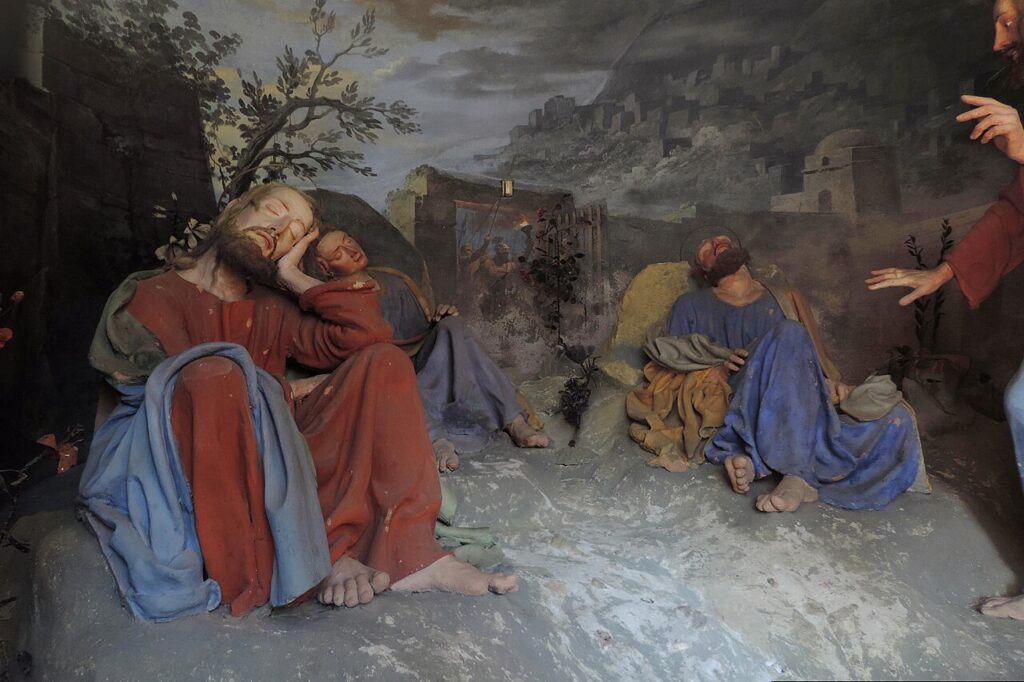
Cappella 22: Gesu’ Sveglia i Discepoli Dormienti, Sacro Monte di Varallo Sesia, Piedmont, Italy. https://commons.wikimedia.org/wiki/File:Varallo_Sesia,Sacro_Monte–Chapel_22-_Jesus_Awakens_the_Sleeping_Disciples_001.jpg
Our reading for Maundy Thursday is Mark 14:32–42. The warmth and memory of the Upper Room were behind Jesus now. The bread, the wine, the final words of love spoken over his closest friends — all of it faded as Jesus stepped into the cold darkness of the garden of Gethsemane. With the city asleep and the shadows deep, the Son of God faced the loneliest moment in human history. He brought his three closest disciples — Peter, James, and John — and asked one thing of them: “Remain here, and keep awake” (Mark 14: 36). But they slept. In his hour of greatest need, the people he loved most could not stay awake. Jesus was left to wrestle alone. And wrestle he did. The Gospel writers search for words to describe what happened next in Gethsemane, and even their most powerful language falls short in conveying what he went through. He was “distressed and agitated,” “grieved and agitated,” “greatly distressed and troubled,” “deeply distressed and horrified,” “sore amazed, and to be very heavy,” “deeply grieved,” “exceedingly sorrowful, even to death.” This was not mild anxiety. This was a soul bearing the full weight of human sin, facing a cross no human heart was ever designed to carry. And so he prayed — not with polished theological language, but with raw, desperate honesty: “Abba, Father, for you all things are possible; remove this cup from me” (Mark 14:36). This is one of the most important prayers in all of Scripture, because Jesus shows us something we often forget: authentic prayer is not the absence of fear. It is the presence of honesty. He did not pretend or perform. He brought his deepest fears directly to the Father, and he asked — plainly, urgently — for another way. The Father did not remove the cup. Yet he did not leave his Son alone either. An angel appeared to strengthen him. And here is the truth that changes everything: the Father’s “No” to escape was a “Yes” to endurance. God did not take away the suffering — he gave Jesus the strength to walk through it. And then came the pivot point of all history: “yet not what I want but what you want.” In His sufferings, Jesus did not bypass his humanity — he walked through it completely. He surrendered his will to the Father’s, trusting that the path of suffering was not the end of the story. This is why, three days later, the garden of agony became the garden of resurrection. Perhaps you are in your own Gethsemane right now. A diagnosis. A broken relationship. A door that will not open no matter how hard you knock. You have prayed — sincerely, repeatedly — and the answer feels like silence, or worse, a quiet and resolute “No.” Bring it to the Father anyway. Ask honestly. Ask urgently, as Jesus did. And if the cup does not pass, if healing does not happen, trust that the same God who strengthened his Son in the garden will strengthen you. Your pain is not a sign that God has abandoned you. It is the very place where he meets you. And remember the sleeping disciples. When someone you love is in their Gethsemane, do not fall asleep on them. Stay present. Sit in the dark with them. Sometimes the most Christlike thing we can do is simply refuse to leave our friends.
What is the cup you are afraid to drink today? Can you bring it — honestly, without pretending — to the Father, and ask him not just to remove it, but to give you the strength to face it?
In Mark 11: 15-19 we read that as Jesus rode into Jerusalem for Passover; the city buzzed with anticipation. Families were scrubbing their homes, removing every crumb of yeast in honor of their liberation from Egypt. It was a season of intense spiritual preparation. Yet when Jesus entered the Temple — the one place where God’s presence was meant to dwell — he found something deeply troubling.
Instead of sanctity and sincere prayer, the air was thick with the bleating of lambs, the clinking of coins, and the smell of animals. The Court of the Gentiles — the only space in the entire Temple complex where non-Jews could come to seek God — had been transformed into a bustling marketplace. This was not merely a case of greed hiding behind religion. The deeper wound that troubled Jesus was exclusion.
By design, this outer court was meant to be a sanctuary for “foreigners coming from a distant land, so that all the peoples of the earth may know God’s name” (2 Chronicles 6:32–33). But the religious leaders had turned it into a religious flea market. The noise of commerce had drowned out the whispers of prayer, and the very people the prophets promised (Isaiah 56:7) God would gather had been excluded.
Jesus responded with righteous indignation. He drove out the animals with a whip, overturned the tables, and declared: “Is it not written, ‘My house shall be called a house of prayer for all the nations’? But you have made it a den of robbers” (Mark 11:17). He was not angry at the need for sacrifice or currency exchange. He was furious that the system had become a barrier — that the religious elite had built a wall where a door should have been.
This story forces us to look honestly at our own temples — our sanctuaries, our denominations, our theologies, our churches, and our communities.
We don’t need to sell doves or lambs to block people from God today. We do it by making our spaces so program-heavy and internally focused that there is no room left for the seeker. We do it when our budgets, buildings, and business efficiency matter more than the mission of God. We do it whenever the outsider — the skeptic, the refugee, the broken, the one who doesn’t look or think like us, those who do not fit our mold — feels unwelcome or unheard.
In cleansing the temple, Jesus proclaimed that he came not just to fix a building, but to restore access to God. And ultimately, he pointed to himself as the true Temple. On the cross, the veil was torn and the barrier destroyed forever: “He is our peace; in his flesh he has broken down the dividing wall, the hostility between us” (Ephesians 2:14).
Today, Jesus invites us to let him search our beliefs, hearts and our churches — to clear out the noise of self-importance and make room again for the outsider.
Who is the “Gentile” or the “other” in your life right now—the person who feels on the outside looking in? How can you make space for them to pray, to be heard, and to belong?
Most of us picture Jesus’ suffering as concentrated into two defining moments — the forty days of temptation in the wilderness, and the final agonizing hours on the cross. But a closer reading of the Gospels reveals something more painful and more personal: rejection was not an exception in Jesus’ life. It was the atmosphere he breathed, from the very beginning to the very end.
It started at birth. Before he could walk or speak, he was already unwanted — a refugee infant carried by desperate parents into a foreign land, fleeing a king who wanted him dead. He grew up displaced, returning to Galilee as a stranger in his own homeland. And it never really got easier.
In Mark 10: 13-16, his own disciples — the men he had personally chosen and poured himself into — tried to turn children away from him. Not strangers. Not enemies. His closest friends from Galilee! Jesus was so troubled by this that the text says he was “indignant.” The very people entrusted with his message were the ones most likely to miss its point.
On the road to Jerusalem, an entire Samaritan village rejected him and didn’t want to have anything with Jesus. His disciples, James and John, were furious and asked Jesus to call down fire from heaven on the village. Jesus rebuked them. Not because he lacked the power, but because his mission was never destruction — it was always redemption.
And then there was Judas. A man who had sat at his table, heard his teaching, and witnessed his miracles — who sold him for the price of a common slave.
So how did Jesus survive it — not just the cross, but a lifetime of rejection?
His identity was not built on the approval of people. It was anchored in something no one could take from him — the voice of the Father, who had spoken over him at his baptism: “You are my beloved Son.” When the crowds called him a drunkard, a madman, demon-possessed, he did not crumble. He knew who he was because the Father had already said so.
And because his identity was secure, rejection could not control his behavior. He didn’t lash out at the disciples who kept getting it wrong. He didn’t curse the village that turned him away. He didn’t become bitter toward Judas. He absorbed the pain — and responded with love anyway.
This is where the story becomes personal.
Most of us handle rejection by building walls, going quiet, or nursing a wound until it hardens into bitterness. Jesus invites us into something harder and more beautiful: to love the people who have hurt us, not because they deserve it, but because we have been loved the same way.
He was rejected so that you could be accepted. He carried the world’s hostility so you would not have to carry it alone.
Who is the person in your life right now who has rejected you? Who is your Samaritan? Who is your Judas? What would it look like today — not someday, but today — to choose love instead of bitterness, trusting that your worth is secured not by their opinion, but by what God the Father thinks and says about you.
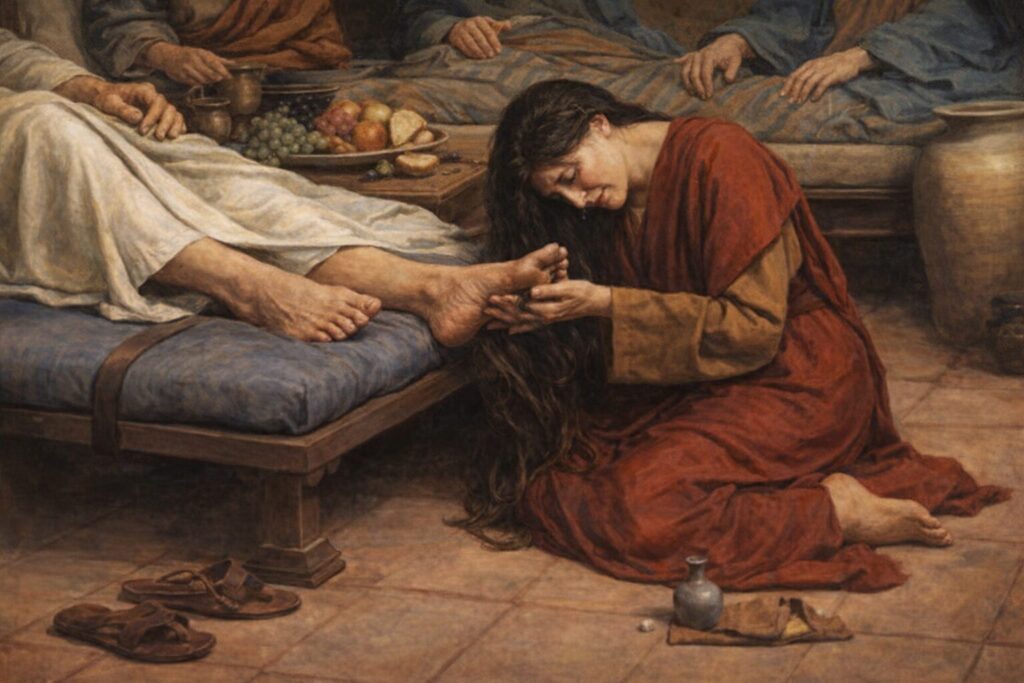
In Luke 7:36–50, an unnamed woman — unwanted, uninvited, and labeled a “sinner” — crashes a dinner party hosted by Simon, a self-righteous Pharisee. To understand just how radical this encounter is, we need to step into its cultural context.
In first-century Judea, dinner guests reclined on cushions around a low platform, feet stretched out behind them. Such gatherings were semi-public, meaning outsiders could slip in and observe. This woman seized that opportunity. She entered a space where she did not belong, carrying one of her most precious possessions — an alabaster flask of expensive perfume.
She did not approach Jesus with a demand, but with a desperation that transcended social shame. Standing behind him, she wept, bathing his feet with her tears, drying them with her hair, kissing them, and anointing them with the perfume. The text does not specify the nature of her sin — only that she was known as a sinner. Yet in the presence of Jesus, deep conviction and remorse poured out of her in tears.
Simon watched in scandalized silence. His objection was not merely personal disgust but a theological crisis: a true prophet, he reasoned, would never allow a ritually unclean person to touch him. In Simon’s worldview, holiness meant keeping the “dirty” at a safe distance.
Jesus dismantled this logic — not with anger, but with a parable. He described two debtors, one forgiven a great debt and one a small one, and asked Simon which would love more. Simon answered correctly: the one forgiven most. That was precisely the point. The woman’s extravagant act was not a payment to earn Jesus’ favor — it was the inevitable overflow of a heart that understood how much she had been released from. She loved much because she had been forgiven much. Simon, who felt he owed little, loved little.
Jesus was teaching something that overturned the religious logic of his day: true holiness is not about avoiding contamination. It is about the power to transform. He did not shrink from her presence — he embraced it, and declared, “Your sins are forgiven. Your faith has saved you. Go in peace.”
This story confronts us on two fronts.
First, where are we like the woman? Have we been labeled, rejected, or told we are too far gone? This story declares that no amount of shame is greater than his grace. We can approach him exactly as we are.
Second — and more uncomfortably — where are we like Simon? Do we prioritize correct behavior over compassionate engagement? Do we quietly want Jesus to join us in condemning the “other,” people different from us whom we have already written off? Jesus does not call the righteous. He calls sinners. And in doing so, he invites us to stop judging the broken and start loving them — risking our own reputations to extend the same grace we so desperately need ourselves.
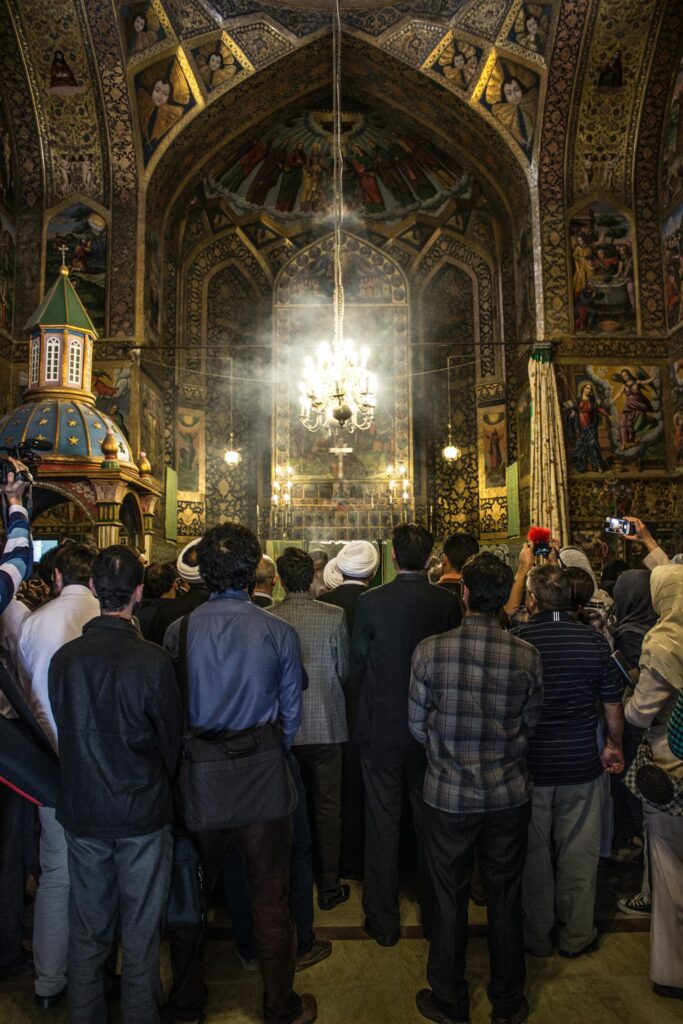
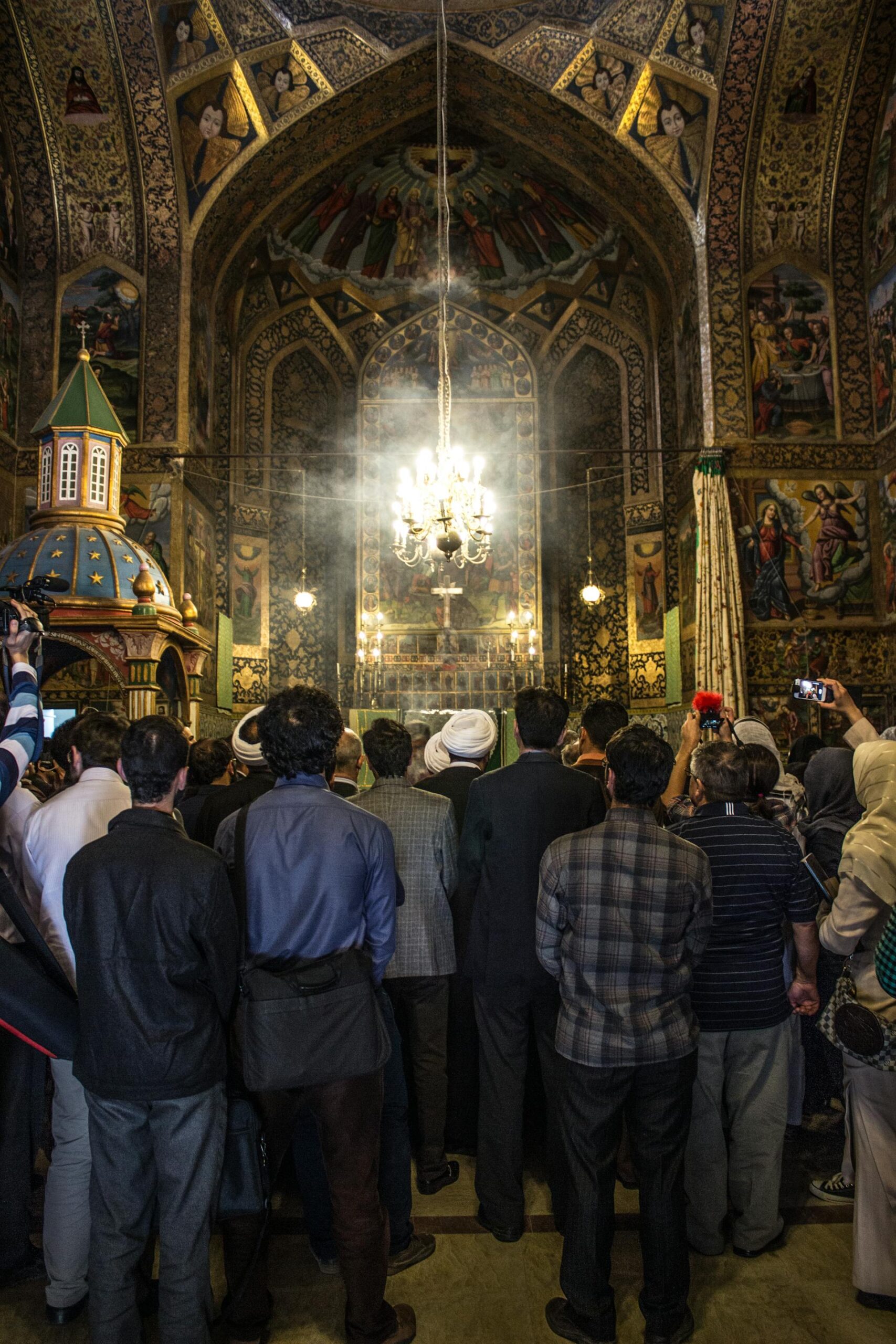
Church in Isfahan, Iran, Photo by Mehdi Khoshnejad: https://www.pexels.com/photo/diverse-congregation-inside-armenian-church-33701903/
Recently, I saw a pastor’s social media post that said, “As a result of today’s [February 28th, 2026] actions led by the USA and Israel, soon Iran will be open for us to preach the Gospel of Jesus Christ within their borders.” This kind of ignorance about Iran and the gospel is quite widespread in some Evangelical circles, as people often think about the history of Christianity in relation to Rome, Byzantium, or medieval Europe. Yet some of the oldest and most enduring Christian traditions developed far to the east—in the lands that now form modern Iran.
The story of Christianity in Iran stretches back nearly two thousand years. It is a story marked by remarkable expansion, cultural exchange, long periods of hardship, and a remarkable revival in recent decades. Above all, it reveals how a church can adapt and survive within changing and adverse political and cultural landscapes.
The Earliest Roots
The connection between Christianity and the Iranian world appears almost immediately in the New Testament itself. In the Acts of the Apostles, the crowd gathered in Jerusalem at Pentecost included people from Parthia, Media, and Elam—regions that correspond broadly to parts of modern Iran (cf. Acts 2:9). If this account reflects historical reality, Iranians were present when the Christian message was first proclaimed beyond the small circle of Jesus’ earliest followers.
Traditions preserved in Syriac Christian writings later expanded on this early connection. According to these accounts, the Apostles Thaddeus and Bartholomew traveled eastward and preached in territories that lay within the Persian cultural sphere. Historians debate the exact details of these traditions, but there is little doubt that Christian communities existed in Persia by the first centuries of the church.
By the second century, these communities had developed a recognizable structure. The bishop of Ctesiphon—the capital of the Sasanian Empire—emerged as the leading authority among Persian Christians and eventually took the title of Catholicos, and later Patriarch. From this center developed what historians now call the Church of the East, a church that grew largely independent from the Christian institutions of the Roman and Byzantine worlds.
This independence shaped the character of Christianity in Iran. Rather than simply copying the forms of Christianity that emerged in the Mediterranean, Persian Christians developed institutions, leadership structures, and theological traditions suited to life within the Sasanian Empire.
Christianity on the Silk Road
One of the most remarkable aspects of Iranian Christianity is how far it spread. From the Persian heartland, Christian missionaries traveled east along the Silk Road, establishing communities across Central Asia and eventually reaching China.
The most famous testimony to this early global presence is the Xi’an Stele, erected in China in AD 781. The inscription recounts how Christian missionaries from the Persian Church of the East arrived in the Tang Empire centuries earlier and established churches there. It stands today as one of the clearest pieces of evidence that Christianity had become a global faith long before the European missionary era.
This expansion also encouraged a process of cultural blending. Christian communities adopted local languages, interacted with Persian intellectual traditions, and adapted their practices to the societies around them. Rather than existing as isolated enclaves, they became part of a broader network of religious and cultural exchange across Asia.
Even today, physical reminders of this early history remain in Iran. Among the most notable is the Monastery of St. Thaddeus, sometimes called Qara Kelisa or the “Black Church.” Dating back at least to the fourth or fifth century, it is one of the oldest surviving Christian sites in the region and a reminder of how deeply rooted Christianity once was in the Iranian world.
Continuity Amidst Political Upheaval in the Later Centuries
Over the centuries, Christianity in Iran developed into a mosaic of different communities, each with its own language and traditions.
For much of late antiquity and the medieval period, the Assyrian Church of the East formed the backbone of Iranian Christianity. Its clergy wrote theological works in Syriac, trained scholars, and maintained networks of churches that extended far beyond Persia itself.
Another major Christian presence was the Armenian Apostolic Church. Armenians had lived in the region for centuries, but their role expanded dramatically during the Safavid era in the seventeenth century. Shah Abbas I relocated large numbers of Armenian merchants to the newly established district of New Julfa in Isfahan. New Julfa quickly became a thriving Armenian community. Its merchants operated trading networks that connected Iran with Europe and Asia, while its churches and schools turned it into one of the most vibrant Christian cultural centers in the Middle East.
Other traditions followed. The Chaldean Catholic Church emerged through union with Rome in the sixteenth century. In the nineteenth century, Protestant missionaries arrived as well, establishing schools, printing presses, and hospitals. The American missionary Justin Perkins, for example, founded educational and publishing institutions in Urmia that helped produce Christian literature in local languages and train indigenous clergy.
These communities illustrate a key feature of Iranian Christianity: its ability to adapt to new circumstances while maintaining continuity with older traditions.
Hard Times and Survival
Christian communities in Iran have rarely enjoyed a completely stable existence. Their history includes long periods of tolerance, but also episodes of persecution and political pressure.
One of the earliest major crises occurred during the fourth century under the Sasanian ruler Shapur II, when Christians were targeted amid tensions between the Persian Empire and the Christian Roman world. Later, after the Arab conquest of the seventh century, Christians became part of the dhimmi system, which recognized them as protected minorities but placed them in a subordinate legal position.
The upheavals of later centuries were often even more devastating. The campaigns of Timur in the fourteenth century destroyed many Christian communities across the region. In the early twentieth century, the Armenian and Assyrian genocides during the collapse of the Ottoman Empire killed hundreds of thousands and forced large populations to flee.
Despite these shocks, Christianity did not disappear from Iran. Armenians, Assyrians, and other communities continued to maintain churches, schools, and cultural institutions, preserving a heritage that stretched back more than a millennium. Moreover, as per Article 64 of Iran’s constitution, Christians receive three of the five guaranteed reserved seats in the Parliament (Majlis) allocated for the recognized minorities.
Christianity in Modern Iran
The Iranian Revolution of 1979 transformed the country’s political and religious environment. The new constitution recognized Armenians and Assyrian-Chaldeans as official religious minorities with the right to maintain churches and representation in parliament. At the same time, conversion from Islam remained legally sensitive and sometimes dangerous. These restrictions led many historic Christian communities to emigrate, forming large diaspora populations in Europe, North America, and Australia.
Yet in an unexpected twist, which can only be attributed to the work of the Holy Spirit, Christianity has also experienced new interest within Iran itself. In recent decades, small groups of Persian-speaking Christians have begun meeting in informal house churches, often gathering quietly in private homes rather than traditional church buildings, as was the norm in the early church. The spread of digital communication has accelerated this process. Persian-language Bibles, sermons, and theological discussions circulate widely through satellite television and online platforms, allowing people to explore Christian teaching privately.
However, I will not venture on to quantify the number of Christians in this new growth as the numerical measuring of the movement is extremely difficult, since many communities operate quietly and without formal institutions. Even so, a growing body of research suggests that a small but notable number of Iranians have adopted Christian beliefs in recent decades. I like to term it as believing in Christ without belonging to the institutionalized church (Cf. John, Vinod: Believing Without Belonging?, 2020).
An Ongoing Story
Considering this historical sketch, Christianity in Iran is not simply a story of survival. It is a story of adaptation, cultural exchange, and resilience across two millennia of political change.
From its early beginnings in the apostolic era, to its role in spreading Christianity across Asia, to the endurance of Armenian and Assyrian communities, and the current unprecedented growth of the non-institutional faith, Iranian Christianity has continually reshaped itself in response to the world around it.
Today, historians increasingly view Iran as an important case study in the broader history of global Christianity. It demonstrates how religious traditions can persist—and sometimes even grow—in circumstances that appear unfavorable.
The full story is still being uncovered as the complex heritage of Christianity in Iran continues to come into clearer view. What is already evident, however, is that this ancient tradition remains an integral part of the wider history of Christianity—and a reminder of the enduring power of the Gospel to not only survive but thrive across centuries of change.
Selected Sources
Adang, C., & Schmidtke, S. (2010). Contacts and Controversies between Muslims, Jews and Christians in the Ottoman Empire and Pre-Modern Iran.
Baghdiantz-MacCabe, I. (2005). The Urban Setting of New Julfa in Safavid Isfahan. Revue des mondes musulmans et de la Méditerranée.
Ghougassian, V. S. (1995). The Emergence of the Armenian Diocese of New Julfa in the Seventeenth Century. ProQuest Dissertations.
Hopkins, P. O. (2018). Iran’s Ethnic Christians: The Assyrians and Armenians. Journal of the Evangelical Theological Society, 61(1), 137–152.
John, Vinod (2020). Believing Without Belonging?: Religious Beliefs and Social Belonging of Hindu Devotees of Christ. Pickwick Publications, Oregon.
Matthee, R. (2020). Safavid Iran and the Christian Missionary Experience. MIDÉO.
Miller, D. A. (2015). Power, Personalities and Politics: The Growth of Iranian Christianity since 1979. Mission Studies, 32(1).
Moreen, V. B. (1981). The Status of Religious Minorities in Safavid Iran. Journal of Near Eastern Studies.
Römer, B. (2024). Becoming Christian, Remaining Iranian: Identity in Iranian Evangelical Communities.
Sanasarian, E. (2000). Religious Minorities in Iran. Cambridge University Press.
Tajarian, Y., & Gasparyan, G. (2025). New Julfa as a Juncture of Armenian, European, and Persian Art. Orient.
For communities shaped by faith, the idea that every person bears the image of God is foundational. In Christian theology, this belief—often called the imago Dei (Genesis 1:27)—affirms that every human life carries inherent dignity, worth, and moral significance. That conviction makes dehumanizing language more than a social concern; it makes it a spiritual one.
Across psychology, history, and theology, there is a consistent lesson: when we stop seeing others as fully human, we lower the barriers that protect them from harm.
What Is Dehumanization?
Social psychologists define dehumanization as perceiving or portraying others as less than fully human. Research by Nick Haslam (2006) explains that this can happen in two primary ways:
– Animalistic dehumanization – comparing people to animals or denying them uniquely human traits such as moral sensibility or refinement.
– Mechanistic dehumanization – treating people as objects, tools, or machines, stripped of emotional depth and individuality.
Both forms deny something sacred: the fullness of personhood.
Studies show that when people describe groups as “monkeys,” “apes,” “less evolved,” “uncivilized,” or otherwise less human, they become more supportive of harsh treatment and collective punishment (Kteily & Bruneau, 2017). Albert Bandura’s work on moral disengagement (1999) demonstrates how reframing victims as less than human allows individuals to bypass moral restraint. In simple terms: when dignity is denied, cruelty becomes easier to justify.
For faith communities committed to loving one’s neighbor (Mark 12:31), this research carries sobering implications.
A Painful History: Colonialism and Slavery
History reveals how often dehumanization has been used to defend injustice.
During European colonial expansion, Indigenous peoples were described as “monkeys,” “savages,” or biologically inferior. Black people were sometimes displayed in cages in Europe https://www.theguardian.com/world/2018/apr/16/belgium-comes-to-terms-with-human-zoos-of-its-colonial-past. Such language framed conquest as a civilizing mission rather than violent dispossession. Thinkers such as Aimé Césaire (1955/2000) and Frantz Fanon (1952/2008) argued that colonial systems depended on systematically denying the humanity of the colonized.
In the transatlantic slave trade, enslaved Africans were frequently depicted as animal‑like or naturally suited for bondage. Historian David Brion Davis (2006) documents how pro‑slavery theology and pseudo‑science worked together to rationalize exploitation. Orlando Patterson (1982) described slavery as “social death,” in which people were stripped of recognized personhood.
For people of faith, this colonial history demands humility. Scripture was often misused to justify systems that contradicted the biblical affirmation that all people are made in God’s image. Modern research shows the lingering effects of such imagery. Goff et al. (2008) found that implicit associations linking Black people with apes predicted greater acceptance of violence in simulated policing contexts. Dehumanizing metaphors do not fade harmlessly into history; they shape perceptions across generations.
Genocide and the Erosion of Moral Boundaries
The Holocaust offers one of the clearest examples of how dehumanization enables atrocity. Scholars such as David Livingstone Smith (2011) and Ervin Staub (1989) document how Nazi propaganda portrayed Jews as vermin or parasites. Anthropologist Alexander Hinton (2002) notes similar patterns across genocides: perpetrators first redefine victims as less than human. These patterns echo a biblical warning: when people are treated as objects or enemies rather than neighbors, violence escalates.
It is in this long history of dehumanization that we must view Donald Trump’s recent depiction of former President Barack Obama and his wife Michelle Obama’s heads on the bodies of apes in a jungle. This animalization mirrors earlier rhetoric in which he referred to immigrants as “vermin” or “animals.” Such language contributed to the justification of keeping immigrants in detention centers under horrendous conditions, because they were considered less than human and therefore undeserving of humane treatment.
Why This Matters for Faith Communities Today
Dehumanization rarely begins with violence; it begins with words, images, and small shifts in perception. Subtle forms—such as denying emotional depth to out‑groups (Leyens et al., 2000)—can gradually harden hearts. For communities shaped by faith, guarding language is not about political correctness; it is about spiritual integrity.
If every person reflects God’s image, then reducing anyone to an animal, a caricature, or a colonial stereotype contradicts that sacred truth. It erodes empathy, weakens the bonds of community, and dulls our responsiveness to suffering.
The consistent message across psychology, history, and theology is clear: seeing others as less than human makes injustice easier; seeing others as image‑bearers strengthens compassion and accountability.
In a polarized age, faith communities have an opportunity to model something different: speech rooted in dignity, disagreement without degradation, and conviction without contempt. To defend shared humanity is not only a social responsibility—it is an act of faithfulness to Scripture and to our calling as followers of Christ.
Picture credit: Africans exhibited at the 1914 Jubilee Exhibition in Christiania (Oslo), Norway, taken from : https://commons.wikimedia.org/wiki/File:Jubileumsutstillingen_1914_OB.F08939d.jpg
Selected Sources
Bandura, A. (1999). Moral disengagement in the perpetration of inhumanities. Personality and Social Psychology Review, 3(3), 193–209. Césaire, A. (2000). Discourse on colonialism. Monthly Review Press. (Original work published 1955) Davis, D. B. (2006). Inhuman bondage: The rise and fall of slavery in the New World. Oxford University Press. Fanon, F. (2008). Black skin, white masks. Grove Press. (Original work published 1952) Goff, P. A., Eberhardt, J. L., Williams, M. J., & Jackson, M. C. (2008). Not yet human. Journal of Personality and Social Psychology, 94(2), 292–306. Haslam, N. (2006). Dehumanization: An integrative review. Personality and Social Psychology Review, 10(3), 252–264. Hinton, A. L. (2002). Annihilating difference: The anthropology of genocide. University of California Press. Kelman, H. C. (1973). Violence without moral restraint. Journal of Social Issues, 29(4), 25–61. Kteily, N. S., & Bruneau, E. (2017). Backlash. Journal of Personality and Social Psychology, 112(4), 564–589. Patterson, O. (1982). Slavery and social death. Harvard University Press. Smith, D. L. (2011). Less than human. St. Martin’s Press. Staub, E. (1989). The roots of evil. Cambridge University Press.