Skip to content

Category: Devotions

When God Seems Absent: A Silent Saturday Reflection

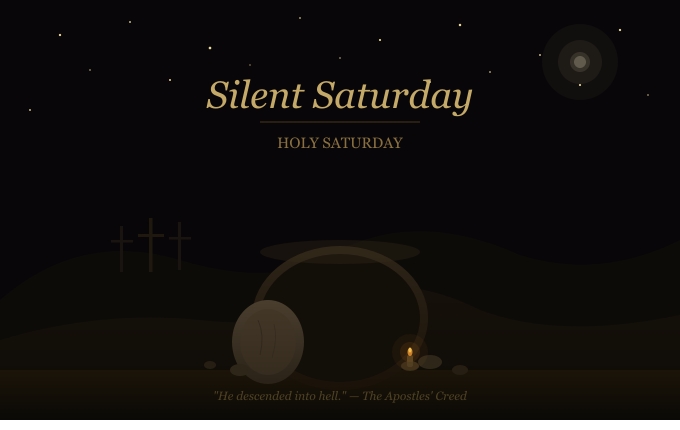
Today marks the final day of the Lenten journey — Holy Saturday, often called Silent Saturday — a day of rest and preparation for the Resurrection. And yet, for all its weight, nobody quite knows what to do with it.


Good Friday has its gravity—the cross, the darkness, the cry of dereliction. Easter has its trumpets. But the day in between just sits there, quiet and strange. The altars are bare. There is no Eucharist, no alleluias. In the old liturgical rhythm, not even a candle is lit. It is the one day of the Church year when the world is simply asked to wait—and waiting, as most of us know, is its own kind of suffering.

Jesus’ disciples certainly found it so. They scattered. They hid. Whatever they had hoped Jesus was, it seemed finished.

But the oldest Christian confession dares to say otherwise. The Apostles’ Creed, in its spare and careful language, declares that after His death, Christ “descended into hell.” Certain Christians anchor this in specific texts, such as, 1 Peter 3:18–20, Ephesians 4:8–9, Acts 2:27, and Matthew 12:40.


However, the original Latin word is inferos, meaning the realm of the dead. The Greek and Hebrew terms, Hades and Sheol, also mean the common realm where human souls go when they leave the body. Therefore, in the Creed, “hell” is not the place of final punishment, but the realm of the dead—the place every human goes. Christ went there because He went everywhere humans go. Jesus did not sidestep death or hover above it. He entered it—all the way in, just as He entered everything else about our condition.


What happened there is where different Christian traditions diverge—and they do so honestly. Eastern Orthodox have long treasured an icon of Christ standing on the splintered gates of Hades, reaching down to pull Adam and Eve out of the dark—a picture of Easter that begins before the stone ever rolls away. Medieval theologians spoke of the righteous dead, the patriarchs and prophets, finally receiving what they had only seen from a distance. Calvin argued the “descent” was not a journey at all but the depth of spiritual suffering Christ endured on the cross—the hell He absorbed so we would not have to bear it. Still other scholars read 1 Peter 3 as Christ declaring His victory to fallen spiritual powers — a proclamation not of mercy but of conquest.


The honest answer is that Scripture leaves this in partial shadow. And perhaps that is fitting. Holy Saturday is, by its nature, the day we cannot fully see into.

What we can say is this: the silence was not emptiness. Wherever Christ was on that Saturday, He was not a victim waiting to be rescued. He was moving through death with the same intention He brought to everything—purposeful, sovereign, undefeated even in the grave.


That matters for more than theology. Most of us know what it is to live in a Saturday season—after something has broken, before anything has been restored. The prayer that hasn’t been answered. The diagnosis that changed everything. The relationship that ended without resolution. The long, grinding wait when Friday’s wound is still fresh and Sunday feels like a rumor.


Holy/ Silent Saturday does not offer cheap comfort. It does not rush you toward the resurrection or tell you to cheer up. What it offers is something stranger—and more solid—than that: the assurance that Christ has already been into the darkest place you’re facing. He didn’t send a message from outside it. He went in. He holds, as He told John, the keys of death and Hades. He didn’t borrow them. He took them.

So, sit in the stillness today if you need to. Name the things that feel sealed and cold. And remember—the silence outside the tomb was not the silence of a story ending. It was the silence before a door flew open from the inside.
He is already there.
The stone will move.
Leave a Comment

Paid in Full: What Jesus Finished on the Cross

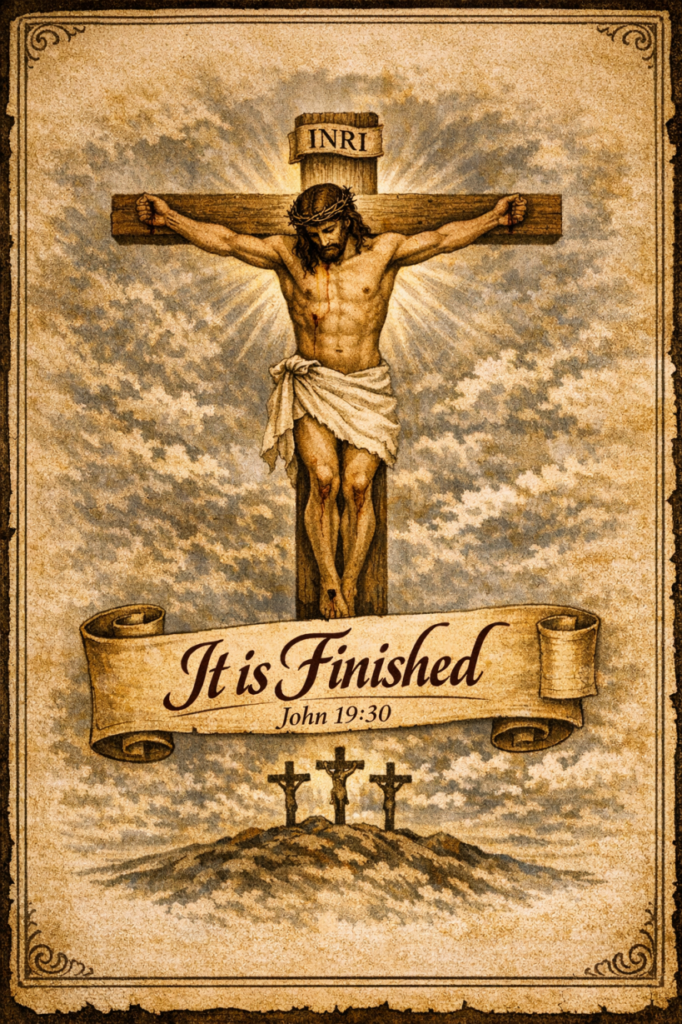
On Good Friday, churches traditionally reflect on the seven “words” of Christ from the cross. While we cannot know exactly how many times Jesus spoke or the precise sequence of his final moments, the Gospel writers have preserved these seven declarations for us. In the churches I have served, it is customary to invite laypeople to speak on these words during the service. Every time I assign them, I face a familiar challenge: everyone has a favorite.

I suspect you do, too. Perhaps it is “Father, forgive them” or “Today you will be with me in Paradise.” But my favorite — the one that haunts and comforts me most — is the final declaration found only in John’s Gospel: “It is finished.”

“When Jesus had received the wine, he said, ‘It is finished.’ Then he bowed his head and gave up his spirit” (John 19:30).

In the original Greek, this phrase is “tetelestai.” The root word, teleo, means “to accomplish,” “finish,” “end,” or “to bring to its intended goal.” Thus, tetelestai carries the weight of “consummated,” “completed,” or “paid in full.” In the first century, this term was stamped on business receipts to indicate a debt had been settled completely.

To me, these three words are among the most profound Jesus ever spoke. No one has ever spoken words richer with spiritual and theological meaning. Their depth is staggering; no human mind can fully fathom the totality of what Jesus meant in that final breath. Yet this declaration stands as the culmination of all human effort to please God and the zenith of God’s work for our salvation.

In this single Greek word tetelestai, the scope of redemption expands infinitely. God’s purpose for the world is fully actualized. Every prophetic utterance of the holy men and women of old finds its “yes” in Christ. All of Jesus’ claims and “I am” statements are confirmed. The long-held aspirations of humanity through the ages are realized. Forgiveness of sins is no longer a hope but a completed reality. The healing of nations and individuals is secured — “by his wounds we are healed” (Isaiah 53:5). The triumph over every enemy is achieved, with death itself as the final foe to be destroyed (1 Corinthians 15:26). And the final redemption of humanity is accomplished (John 3:16).

The list could go on, but the point remains: it is finished. The work is done. The debt is paid.

This is not just a historical event; it is a present reality. We are invited to stop striving and start resting in this accomplishment. Let us not only receive this truth personally but also share it with those who do not yet know the power of a finished work.

. . .

Reflection: Which of these truths do you need to cling to most today? How does the knowledge that the work of your salvation is finished change the way you approach your struggles?

Leave a Comment

When the Answer to Your Prayer Is No: Finding God in Your Gethsemane

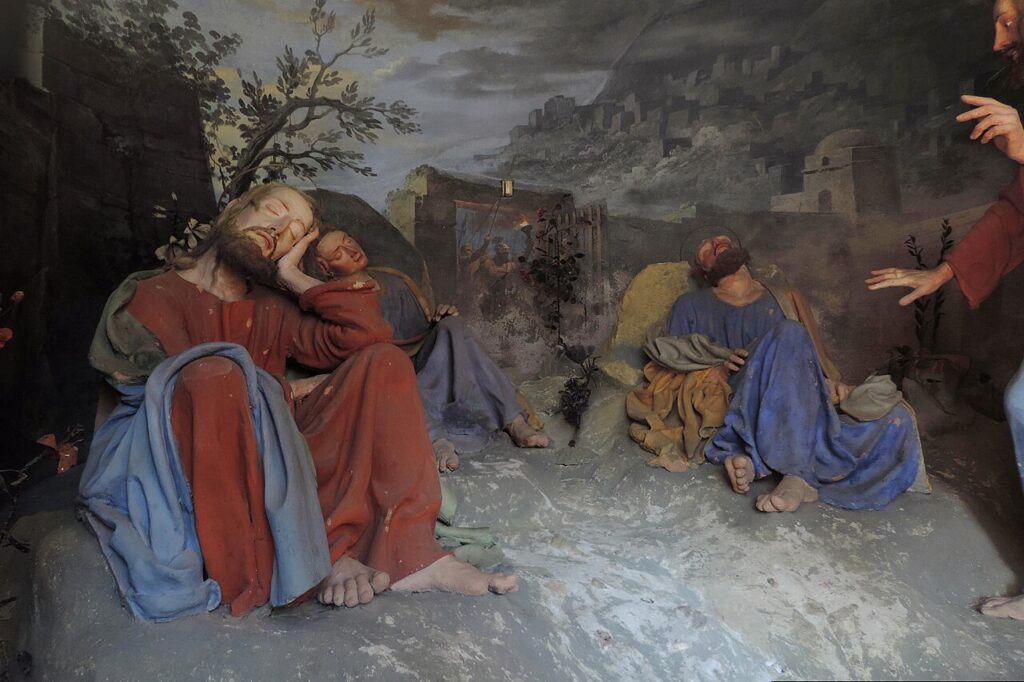
Cappella 22: Gesu’ Sveglia i Discepoli Dormienti‎, Sacro Monte di Varallo Sesia, Piedmont, Italy. https://commons.wikimedia.org/wiki/File:Varallo_Sesia,Sacro_MonteChapel_22-_Jesus_Awakens_the_Sleeping_Disciples_001.jpg

Our reading for Maundy Thursday is Mark 14:32–42. The warmth and memory of the Upper Room were behind Jesus now. The bread, the wine, the final words of love spoken over his closest friends — all of it faded as Jesus stepped into the cold darkness of the garden of Gethsemane. With the city asleep and the shadows deep, the Son of God faced the loneliest moment in human history.
He brought his three closest disciples — Peter, James, and John — and asked one thing of them: “Remain here, and keep awake” (Mark 14: 36). But they slept. In his hour of greatest need, the people he loved most could not stay awake. Jesus was left to wrestle alone.
And wrestle he did. The Gospel writers search for words to describe what happened next in Gethsemane, and even their most powerful language falls short in conveying what he went through. He was “distressed and agitated,” “grieved and agitated,” “greatly distressed and troubled,” “deeply distressed and horrified,” “sore amazed, and to be very heavy,” “deeply grieved,” “exceedingly sorrowful, even to death.”
This was not mild anxiety. This was a soul bearing the full weight of human sin, facing a cross no human heart was ever designed to carry.
And so he prayed — not with polished theological language, but with raw, desperate honesty: “Abba, Father, for you all things are possible; remove this cup from me” (Mark 14:36).
This is one of the most important prayers in all of Scripture, because Jesus shows us something we often forget: authentic prayer is not the absence of fear. It is the presence of honesty. He did not pretend or perform. He brought his deepest fears directly to the Father, and he asked — plainly, urgently — for another way.
The Father did not remove the cup. Yet he did not leave his Son alone either. An angel appeared to strengthen him. And here is the truth that changes everything: the Father’s “No” to escape was a “Yes” to endurance. God did not take away the suffering — he gave Jesus the strength to walk through it.
And then came the pivot point of all history: “yet not what I want but what you want.”
In His sufferings, Jesus did not bypass his humanity — he walked through it completely. He surrendered his will to the Father’s, trusting that the path of suffering was not the end of the story. This is why, three days later, the garden of agony became the garden of resurrection.
Perhaps you are in your own Gethsemane right now. A diagnosis. A broken relationship. A door that will not open no matter how hard you knock. You have prayed — sincerely, repeatedly — and the answer feels like silence, or worse, a quiet and resolute “No.”
Bring it to the Father anyway. Ask honestly. Ask urgently, as Jesus did. And if the cup does not pass, if healing does not happen, trust that the same God who strengthened his Son in the garden will strengthen you. Your pain is not a sign that God has abandoned you. It is the very place where he meets you.
And remember the sleeping disciples. When someone you love is in their Gethsemane, do not fall asleep on them. Stay present. Sit in the dark with them. Sometimes the most Christlike thing we can do is simply refuse to leave our friends.


What is the cup you are afraid to drink today? Can you bring it — honestly, without pretending — to the Father, and ask him not just to remove it, but to give you the strength to face it?

Leave a Comment

The Temple Courtyard Was Full of Noise, But Empty of Prayer

Enrique Simonet, Public domain, https://commons.wikimedia.org/wiki/File:Simonet_-_expulsion_mercaderes.jpg

In Mark 11: 15-19 we read that as Jesus rode into Jerusalem for Passover; the city buzzed with anticipation. Families were scrubbing their homes, removing every crumb of yeast in honor of their liberation from Egypt. It was a season of intense spiritual preparation. Yet when Jesus entered the Temple — the one place where God’s presence was meant to dwell — he found something deeply troubling.

Instead of sanctity and sincere prayer, the air was thick with the bleating of lambs, the clinking of coins, and the smell of animals. The Court of the Gentiles — the only space in the entire Temple complex where non-Jews could come to seek God — had been transformed into a bustling marketplace. This was not merely a case of greed hiding behind religion. The deeper wound that troubled Jesus was exclusion.

By design, this outer court was meant to be a sanctuary for “foreigners coming from a distant land, so that all the peoples of the earth may know God’s name” (2 Chronicles 6:32–33). But the religious leaders had turned it into a religious flea market. The noise of commerce had drowned out the whispers of prayer, and the very people the prophets promised (Isaiah 56:7) God would gather had been excluded.

Jesus responded with righteous indignation. He drove out the animals with a whip, overturned the tables, and declared: “Is it not written, ‘My house shall be called a house of prayer for all the nations’? But you have made it a den of robbers” (Mark 11:17). He was not angry at the need for sacrifice or currency exchange. He was furious that the system had become a barrier — that the religious elite had built a wall where a door should have been.

This story forces us to look honestly at our own temples — our sanctuaries, our denominations, our theologies, our churches, and our communities.

We don’t need to sell doves or lambs to block people from God today. We do it by making our spaces so program-heavy and internally focused that there is no room left for the seeker. We do it when our budgets, buildings, and business efficiency matter more than the mission of God. We do it whenever the outsider — the skeptic, the refugee, the broken, the one who doesn’t look or think like us, those who do not fit our mold — feels unwelcome or unheard.

In cleansing the temple, Jesus proclaimed that he came not just to fix a building, but to restore access to God. And ultimately, he pointed to himself as the true Temple. On the cross, the veil was torn and the barrier destroyed forever: “He is our peace; in his flesh he has broken down the dividing wall, the hostility between us” (Ephesians 2:14).

Today, Jesus invites us to let him search our beliefs, hearts and our churches — to clear out the noise of self-importance and make room again for the outsider.

Who is the “Gentile” or the “other” in your life right now—the person who feels on the outside looking in? How can you make space for them to pray, to be heard, and to belong?

Leave a Comment

Rejected Every Day — He Kept Loving Anyway

Most of us picture Jesus’ suffering as concentrated into two defining moments — the forty days of temptation in the wilderness, and the final agonizing hours on the cross. But a closer reading of the Gospels reveals something more painful and more personal: rejection was not an exception in Jesus’ life. It was the atmosphere he breathed, from the very beginning to the very end.

It started at birth. Before he could walk or speak, he was already unwanted — a refugee infant carried by desperate parents into a foreign land, fleeing a king who wanted him dead. He grew up displaced, returning to Galilee as a stranger in his own homeland. And it never really got easier.

In Mark 10: 13-16, his own disciples — the men he had personally chosen and poured himself into — tried to turn children away from him. Not strangers. Not enemies. His closest friends from Galilee! Jesus was so troubled by this that the text says he was “indignant.” The very people entrusted with his message were the ones most likely to miss its point.

On the road to Jerusalem, an entire Samaritan village rejected him and didn’t want to have anything with Jesus. His disciples, James and John, were furious and asked Jesus to call down fire from heaven on the village. Jesus rebuked them. Not because he lacked the power, but because his mission was never destruction — it was always redemption.

And then there was Judas. A man who had sat at his table, heard his teaching, and witnessed his miracles — who sold him for the price of a common slave.

So how did Jesus survive it — not just the cross, but a lifetime of rejection?

His identity was not built on the approval of people. It was anchored in something no one could take from him — the voice of the Father, who had spoken over him at his baptism: “You are my beloved Son.”  When the crowds called him a drunkard, a madman, demon-possessed, he did not crumble. He knew who he was because the Father had already said so.

And because his identity was secure, rejection could not control his behavior. He didn’t lash out at the disciples who kept getting it wrong. He didn’t curse the village that turned him away. He didn’t become bitter toward Judas. He absorbed the pain — and responded with love anyway.

This is where the story becomes personal.

Most of us handle rejection by building walls, going quiet, or nursing a wound until it hardens into bitterness. Jesus invites us into something harder and more beautiful: to love the people who have hurt us, not because they deserve it, but because we have been loved the same way.

He was rejected so that you could be accepted. He carried the world’s hostility so you would not have to carry it alone.

Who is the person in your life right now who has rejected you? Who is your Samaritan? Who is your Judas? What would it look like today — not someday, but today — to choose love instead of bitterness, trusting that your worth is secured not by their opinion, but by what God the Father thinks and says about you.

Leave a Comment

The Cost of Grace: Reimagining the Other

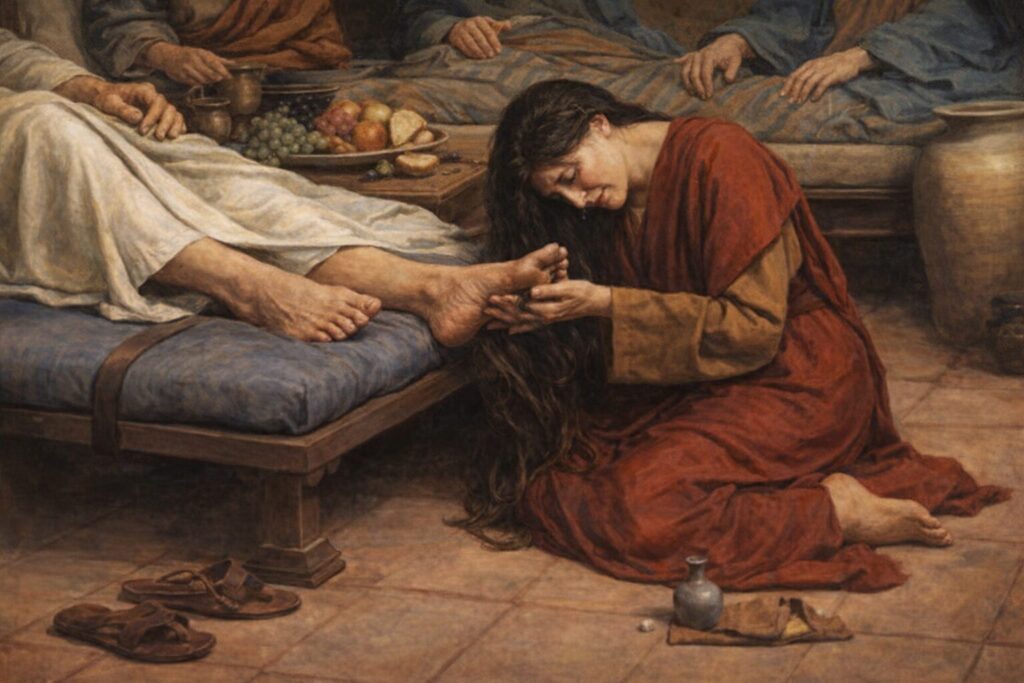
In Luke 7:36–50, an unnamed woman — unwanted, uninvited, and labeled a “sinner” — crashes a dinner party hosted by Simon, a self-righteous Pharisee. To understand just how radical this encounter is, we need to step into its cultural context.

In first-century Judea, dinner guests reclined on cushions around a low platform, feet stretched out behind them. Such gatherings were semi-public, meaning outsiders could slip in and observe. This woman seized that opportunity. She entered a space where she did not belong, carrying one of her most precious possessions — an alabaster flask of expensive perfume.

She did not approach Jesus with a demand, but with a desperation that transcended social shame. Standing behind him, she wept, bathing his feet with her tears, drying them with her hair, kissing them, and anointing them with the perfume. The text does not specify the nature of her sin — only that she was known as a sinner. Yet in the presence of Jesus, deep conviction and remorse poured out of her in tears.

Simon watched in scandalized silence. His objection was not merely personal disgust but a theological crisis: a true prophet, he reasoned, would never allow a ritually unclean person to touch him. In Simon’s worldview, holiness meant keeping the “dirty” at a safe distance.

Jesus dismantled this logic — not with anger, but with a parable. He described two debtors, one forgiven a great debt and one a small one, and asked Simon which would love more. Simon answered correctly: the one forgiven most. That was precisely the point. The woman’s extravagant act was not a payment to earn Jesus’ favor — it was the inevitable overflow of a heart that understood how much she had been released from. She loved much because she had been forgiven much. Simon, who felt he owed little, loved little.

Jesus was teaching something that overturned the religious logic of his day: true holiness is not about avoiding contamination. It is about the power to transform. He did not shrink from her presence — he embraced it, and declared, “Your sins are forgiven. Your faith has saved you. Go in peace.”

This story confronts us on two fronts.

First, where are we like the woman? Have we been labeled, rejected, or told we are too far gone? This story declares that no amount of shame is greater than his grace. We can approach him exactly as we are.

Second — and more uncomfortably — where are we like Simon? Do we prioritize correct behavior over compassionate engagement? Do we quietly want Jesus to join us in condemning the “other,” people different from us whom we have already written off? Jesus does not call the righteous. He calls sinners. And in doing so, he invites us to stop judging the broken and start loving them — risking our own reputations to extend the same grace we so desperately need ourselves.

Leave a Comment

Christmas not so Merry and Bright?: God in Christ Comes to Us in our Messiness

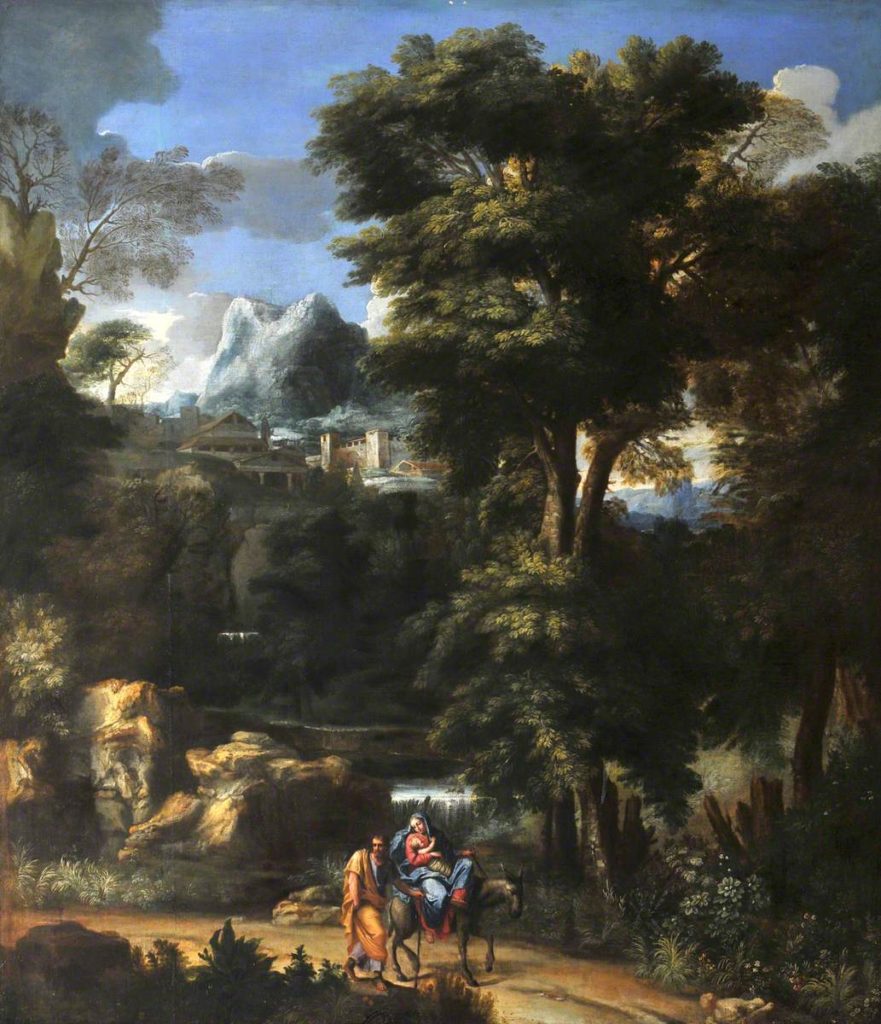
Herault, Charles-Antoine|Coypel, Noel; A Landscape with the Flight into Egypt; National Trust, Tatton Park; http://www.artuk.org/artworks/a-landscape-with-the-flight-into-egypt-131315

If your Christmas is not merry and bright, if it’s blue instead of red, or if it’s lonely instead of a joyful family; just know that it’s absolutely fine. There’s nothing wrong with you or with your Christmas.

The birth of Jesus Christ had nothing to do with such things in the world that He was born and lived in. Instead, the Scriptures show us it was stark and bleak, though not without a ray of hope. Even after the birth, Jesus and his folks had to deal with constant dangers and foreboding, as a refugee family on the run, crossing risky borders while authorities demanded papers and they had none to show.

The Bible talks about a Jesus who comes into the world of violence, fear, misery, poverty, colonization, and injustice. It is in this world that He came naked, homeless, and as one for whom there was no room in anyone’s house or heart. Jesus’ early life was lived as a vulnerable refugee in Egypt at the mercy of strangers who took his family in and provided for them during their sojourn there. Therefore, Jesus Christ can come to you today in your own vulnerabilities and needs and in your lonely space of a godforsaken mess. It was made possible not because of the manger or the cradle but through His cross. May we run to the Cross and find forgiveness, love, mercy, and comfort in whatever situation you find yourself in this Christmas in 2022 on in the new year.

Maranatha!

1 Comment

Epiphany: the journey of a lifetime!

Epiphany: the journey of a lifetime

Epiphany is the manifestation or revealing of Christ celebrated in the Church tradition to commemorate the arrival of Magi from the East to pay their homage to Jesus and to offer their gifts made of gold, frankincense, and myrrh. However, this manifestation or epiphany of the Messiah would not have been possible without the arduous journey and trouble that these Magi undertook to seek and find the Messiah. Therefore, to me, the Epiphany is a reminder of the journey that you and I are on.

We must embark upon this journey by ourselves. There can be no proxy journeys! We cannot find the God Incarnate through someone else’s journey. We may have stories of others seeking and finding God and we must certainly learn from their experiences. However, one must decide to commence their own journey toward God. And God has offered in the past and continues to offer specific firsthand experience to those who seek Him. God promised through the Prophet Jeremiah:

Then when you call upon me and come and pray to me, I will hear you. When you search for me, you will find me; if you seek me with all your heart….

Jeremiah 29: 12-13 NRSV

In the New Testament, too, the writer of the Epistle of James encouraged us saying,

Submit yourselves therefore to God. Resist the devil, and he will flee from you. Draw near to God, and he will draw near to you. Cleanse your hands, you sinners, and purify your hearts, you double-minded.

James 4: 7-8 NRSV

Second, this journeying toward God is a lifelong quest. And there will be time on this journey of drawing near to God where we will find ourselves in troubles and even dangers just like the original Magi who ventured out on a long journey full of challenges including the threat from the political leaders of the time. However, they journeyed on until they found the Messiah. And they were willing to disobey king Herod to flee from Israel through a different and uncertain route. So, despite our challenges, notwithstanding where in our journey we may be, let us resolve along with the Apostle Paul, who after several decades of being on several strenuous missionary journeys, said:

Not that I have already obtained this or have already reached the goal; but I press on to make it my own, because Christ Jesus has made me his own.

Philippians 3: 12 NRSV

Lastly, in our journey toward the Almighty Creator God, the giver of Life, we will encounter all sorts of people who are at different stations of this journey. Since you have come so far or you have achieved great milestones, that others are still striving for, that should make you kind toward others. Let us resolve to offer help to those who you find tired on this journey. There may even be some who are bogged down with the unnecessary baggage they are carrying on this journey toward God. It could be the baggage of their culture, traditions, family background or upbringings. Let us resolve to be a source of encouragement to these fellow travelers on the road to seeking God, especially to those are exhausted for several reasons and want to give up the journey altogether. There may be people who are in the process of deconstructing their faith on this journey. You and I may not fully understand them and their quest, but we can decide to be empathizing and encouraging them and come alongside with them. Let us be people who root for them and encourage them to press on toward God.

Happy Journeying toward the Source of all Life!

2 Comments

Lenten Reflections 2021: The Purpose of the Cross and Good Works

Image by Rodnae productions at Pexels

@johnvinod | April 3, 2021

Today’s reading is from Titus 2: 11-15. On this holy or silent Saturday, as we somberly reflect on the death of Jesus Christ on the cross, I am constrained to suggest its implications for us today. This passage is from the Apostle Paul’s brief pastoral letter to young Titus. This young pastor was faced with several challenges in his walk with Christ as well as in his ministry. He met opposition from within and from the outside. The Apostle Paul’s encouragement and instructions to Titus are drawn from the death of Jesus Christ. He instructs us how to live as the followers of Christ today.

Paul writes,

“while we wait for the blessed hope and the manifestation of the glory of our great God and Savior, Jesus Christ. He it is who gave himself for us that he might redeem us from all iniquity and purify for himself a people of his own who are zealous for good deeds” (Titus 2: 13-14).

Paul unmistakably paints a picture of the purpose of the death of Christ on the cross. Through Jesus’ death, he has not only redeemed us from all our sins, but also purified/sanctified us for himself as a holy people. However, I want us to focus today only on the concluding part of the sentence. What is the purpose of God in achieving this through the death on the cross? The purpose is to make us passionate for good deeds or works!

Yes, the grace saves us, but we are also saved for good works, as Paul said in Ephesian 2: 8-10. We, who claim to know God, understand him from what he has done for us. Through what Jesus did on the cross, he demonstrated his zeal for the Father’s honor and mission on earth.

In the same manner, the cross should inspire us to work in such a way that God would be known to those around us by what we do and not just by what we believe or preach. The purpose of God in saving us through the cross of Christ is not to rush through this life for that “pie in the sky” when we die. Rather, his purpose is to make us workers for his Kingdom. That is why when Jesus called his disciples, he made it clear to them, “Follow me, and I will make you fishers of men” (Matthew 4: 19). The cross must not only provoke the zeal, but may it also inspire us to do good, even though death confront us in the path of doing good works for the Master!

In our contemporary culture of comfort, ease, and outsourcing everything to others, there is little fruit in the vineyard of God in many places. We frequently meet spent ministers and barren churches. The need of the hour is to recognize that Jesus Christ did not die on the cross to make us comfortable in the lofty theology of our individualistic redemption and the holier-than-thou denominationalized purity. Instead, let us refocus our gaze upon the cross to make us fervent for the good works of his Kingdom. Being complacent or becoming “at ease in Zion” or to “feel secure on the mountain of Samaria” (Amos 6:1), are unbecoming of the cross of Christ. Therefore, while you and I still enjoy peace, health, and wealth, let the cross motivate us to go and work with zeal in his vineyard. Amen.


For a paperback, please contact vinod@vinodjohn.com

Leave a Comment

Lenten Reflections 2021: What Can an Unnamed Soldier Teach Us?

Photo by Slices of Light on Flickr

@johnvinod | April 2, 2021

Let us read Matthew 27: 45-54. In the account of the crucifixion and death of Jesus Christ, there are so many people, aspects, and incidents in a matter of just a few hours. One could spend a lifetime studying these particulars, meditating, and learning from them. However, for me, one remarkable character who stands out on the Calvary hill is the unnamed Roman centurion. Why so? It is due to his confessional statement, “Truly this man was God’s Son!” (Matthew 27: 54 NRSV), or “Truly this was the Son of God!” (ESV). This extraordinary confession comes under circumstances like no other.

A Roman centurion was in command of about one hundred soldiers. He must have been an experienced soldier, a responsible man with authority, who was well trained and well paid. He appears to be the supervisor of the crucifixion of Jesus Christ along with two other small-time criminals, making sure the job was done right and on time.

Therefore, let us consider how the Roman centurion confessed faith in Jesus Christ. Most of the disciples had abandoned Jesus. They went into hiding for fear of the Romans and the Jewish religious authorities. It was only after the resurrection of Jesus Christ that they begin to gradually come out in the open and trusted his claims. The resurrected messiah appeared to the disciples in his glorious body, defying gravity and the laws of nature, making it easier to put faith and follow him. But the centurion confessed before the resurrection.

The centurion keenly studied everything about Jesus since morning. He must have wondered about everything Jesus said and did; and also, all that he did not say or do even when provoked. He must have witnessed many people die, but none died like Jesus. He must have pondered who was this man on the cross. He must have wondered if the forgiveness Jesus offered before he breathed his last was still available to him, for the centurion truly did not know what he was doing that day. Finally, “when the centurion, who stood facing him, saw that in this way [Jesus] breathed his last, he said, “Truly this man was the Son of God!” (Mark 15: 39 ESV).

Let us consider the scenario:

When on a small hill, where no one ever wanted to be, he noticed a frail man, almost naked, completely bruised and forgiving others, the centurion confessed his divinity.

When everyone laughed shaking their head reading the plaque with an indictment placed above the head of Jesus’ cross, the centurion confessed his divinity.

When Jesus cried out “My God, my God, why have you forsaken me?”, the centurion confessed his divinity.

When Jesus died on the cross, as a helpless man rejected and condemned by everyone, the centurion confessed his divinity.

When Jesus truly was a picture-perfect representation of a prophecy of the Prophet Isaiah; knowing not of this prophecy, the centurion confessed his divinity.

He had no form or majesty that we should look at him,

    and no beauty that we should desire him.

He was despised and rejected by men,

    a man of sorrows and acquainted with grief;

and as one from whom men hide their faces

    he was despised, and we esteemed him not (Isaiah 53: 2b -3 ESV).

When Jesus Christ had just breathed his last, right in front of the centurion, with a prayer on his parched lips, the centurion confessed his divinity.

When almost naked, listless body of Jesus was dangling from the cross, a symbol of shame and curse, the centurion confessed his divinity.

When he saw the midday sky turn dark, and witnessed his world enveloped in thickening gloom, the centurion confessed Jesus’ divinity.  

When he did not know any claims about his resurrection, the centurion confessed Jesus’ divinity.

When the resurrection had not yet occurred, the centurion confessed Jesus’ divinity.

In the contemporary culture, where people like and follow the rising stars, popular preachers, celebrity pastors, published authors, tenured professors, narcissistic politicians, and suchlike; Jesus Christ counters it all by his barbaric death on the cross. However, the centurion advises us today to examine our motives, faith, confessions, creeds, and the spiritual inclinations. May we stand in rapt silence contemplating the mystery of the death of Jesus Christ, as the centurion did over 2000 years ago. And may we, too, follow the humble, humiliated, suffering, crucified Son of God; even when it goes against the trends of our culture. Amen.


For a paperback contact: vinod@vinodjohn.com

Leave a Comment

You have successfully subscribed to our blog. Thank you!

There was an error while trying to send your request. Please try again.

You agree to receive posts and updates from this site through the above email Id.