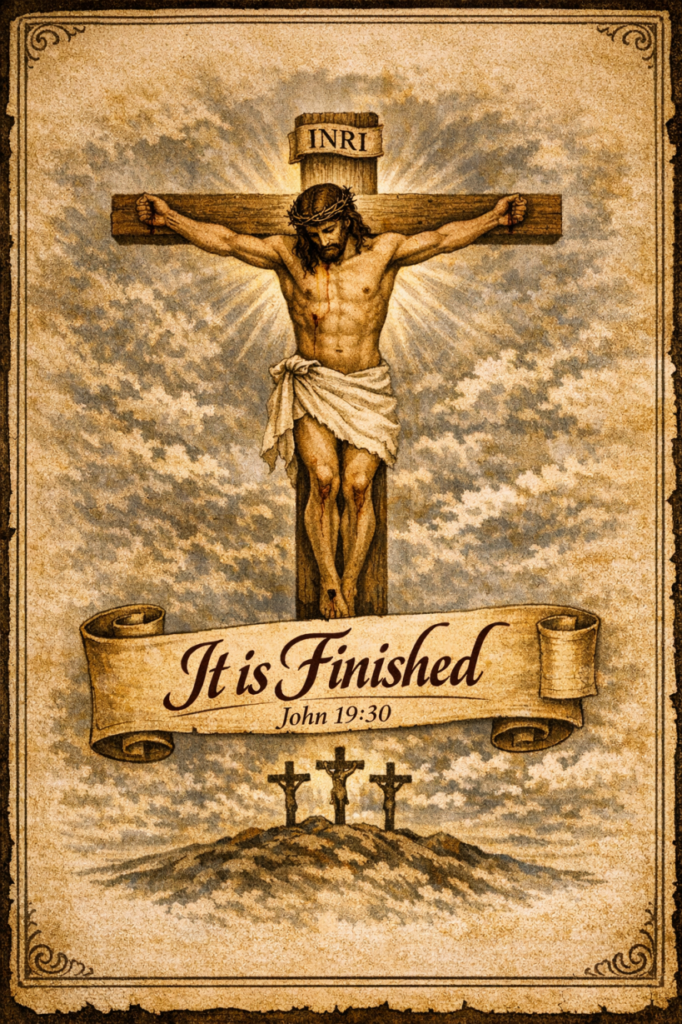
On Good Friday, churches traditionally reflect on the seven “words” of Christ from the cross. While we cannot know exactly how many times Jesus spoke or the precise sequence of his final moments, the Gospel writers have preserved these seven declarations for us. In the churches I have served, it is customary to invite laypeople to speak on these words during the service. Every time I assign them, I face a familiar challenge: everyone has a favorite.
I suspect you do, too. Perhaps it is “Father, forgive them” or “Today you will be with me in Paradise.” But my favorite — the one that haunts and comforts me most — is the final declaration found only in John’s Gospel: “It is finished.”
“When Jesus had received the wine, he said, ‘It is finished.’ Then he bowed his head and gave up his spirit” (John 19:30).
In the original Greek, this phrase is “tetelestai.” The root word, teleo, means “to accomplish,” “finish,” “end,” or “to bring to its intended goal.” Thus, tetelestai carries the weight of “consummated,” “completed,” or “paid in full.” In the first century, this term was stamped on business receipts to indicate a debt had been settled completely.
To me, these three words are among the most profound Jesus ever spoke. No one has ever spoken words richer with spiritual and theological meaning. Their depth is staggering; no human mind can fully fathom the totality of what Jesus meant in that final breath. Yet this declaration stands as the culmination of all human effort to please God and the zenith of God’s work for our salvation.
In this single Greek word tetelestai, the scope of redemption expands infinitely. God’s purpose for the world is fully actualized. Every prophetic utterance of the holy men and women of old finds its “yes” in Christ. All of Jesus’ claims and “I am” statements are confirmed. The long-held aspirations of humanity through the ages are realized. Forgiveness of sins is no longer a hope but a completed reality. The healing of nations and individuals is secured — “by his wounds we are healed” (Isaiah 53:5). The triumph over every enemy is achieved, with death itself as the final foe to be destroyed (1 Corinthians 15:26). And the final redemption of humanity is accomplished (John 3:16).
The list could go on, but the point remains: it is finished. The work is done. The debt is paid.
This is not just a historical event; it is a present reality. We are invited to stop striving and start resting in this accomplishment. Let us not only receive this truth personally but also share it with those who do not yet know the power of a finished work.
. . .
Reflection: Which of these truths do you need to cling to most today? How does the knowledge that the work of your salvation is finished change the way you approach your struggles?
Leave a Comment