Recently, I saw a pastor’s social media post that said, “As a result of today’s [February 28th, 2026] actions led by the USA and Israel, soon Iran will be open for us to preach the Gospel of Jesus Christ within their borders.” This kind of ignorance about Iran and the gospel is quite widespread in some Evangelical circles, as people often think about the history of Christianity in relation to Rome, Byzantium, or medieval Europe. Yet some of the oldest and most enduring Christian traditions developed far to the east—in the lands that now form modern Iran.
The story of Christianity in Iran stretches back nearly two thousand years. It is a story marked by remarkable expansion, cultural exchange, long periods of hardship, and a remarkable revival in recent decades. Above all, it reveals how a church can adapt and survive within changing and adverse political and cultural landscapes.
The Earliest Roots
The connection between Christianity and the Iranian world appears almost immediately in the New Testament itself. In the Acts of the Apostles, the crowd gathered in Jerusalem at Pentecost included people from Parthia, Media, and Elam—regions that correspond broadly to parts of modern Iran (cf. Acts 2:9). If this account reflects historical reality, Iranians were present when the Christian message was first proclaimed beyond the small circle of Jesus’ earliest followers.
Traditions preserved in Syriac Christian writings later expanded on this early connection. According to these accounts, the Apostles Thaddeus and Bartholomew traveled eastward and preached in territories that lay within the Persian cultural sphere. Historians debate the exact details of these traditions, but there is little doubt that Christian communities existed in Persia by the first centuries of the church.
By the second century, these communities had developed a recognizable structure. The bishop of Ctesiphon—the capital of the Sasanian Empire—emerged as the leading authority among Persian Christians and eventually took the title of Catholicos, and later Patriarch. From this center developed what historians now call the Church of the East, a church that grew largely independent from the Christian institutions of the Roman and Byzantine worlds.
This independence shaped the character of Christianity in Iran. Rather than simply copying the forms of Christianity that emerged in the Mediterranean, Persian Christians developed institutions, leadership structures, and theological traditions suited to life within the Sasanian Empire.
Christianity on the Silk Road
One of the most remarkable aspects of Iranian Christianity is how far it spread. From the Persian heartland, Christian missionaries traveled east along the Silk Road, establishing communities across Central Asia and eventually reaching China.
The most famous testimony to this early global presence is the Xi’an Stele, erected in China in AD 781. The inscription recounts how Christian missionaries from the Persian Church of the East arrived in the Tang Empire centuries earlier and established churches there. It stands today as one of the clearest pieces of evidence that Christianity had become a global faith long before the European missionary era.
This expansion also encouraged a process of cultural blending. Christian communities adopted local languages, interacted with Persian intellectual traditions, and adapted their practices to the societies around them. Rather than existing as isolated enclaves, they became part of a broader network of religious and cultural exchange across Asia.
Even today, physical reminders of this early history remain in Iran. Among the most notable is the Monastery of St. Thaddeus, sometimes called Qara Kelisa or the “Black Church.” Dating back at least to the fourth or fifth century, it is one of the oldest surviving Christian sites in the region and a reminder of how deeply rooted Christianity once was in the Iranian world.
Continuity Amidst Political Upheaval in the Later Centuries
Over the centuries, Christianity in Iran developed into a mosaic of different communities, each with its own language and traditions.
For much of late antiquity and the medieval period, the Assyrian Church of the East formed the backbone of Iranian Christianity. Its clergy wrote theological works in Syriac, trained scholars, and maintained networks of churches that extended far beyond Persia itself.
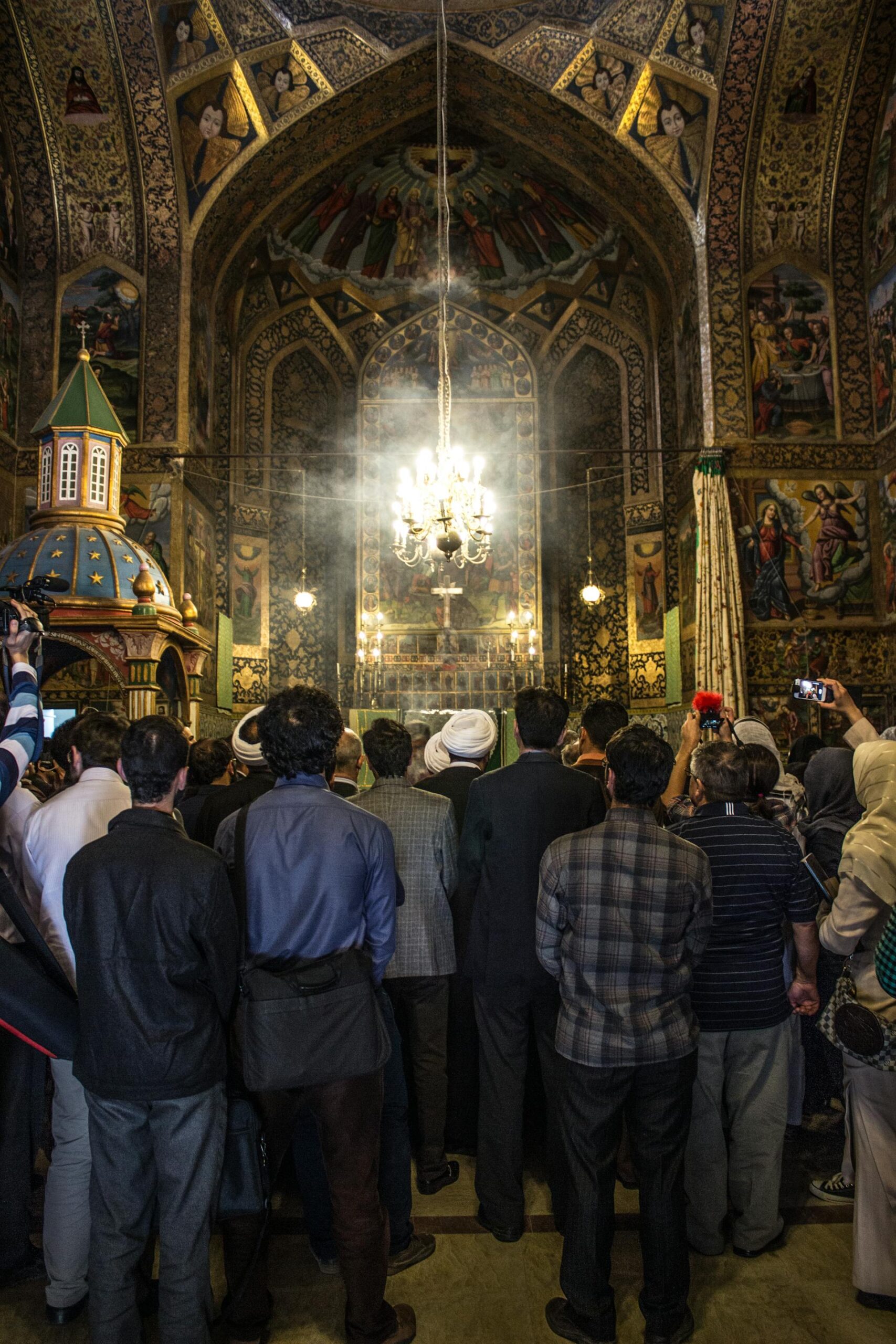
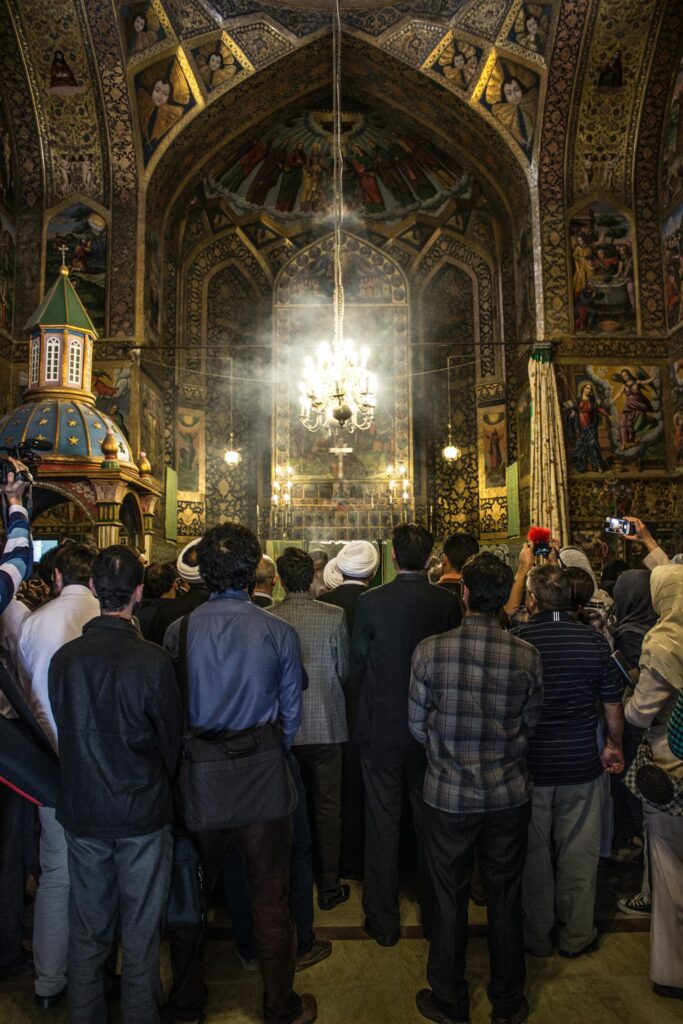
Another major Christian presence was the Armenian Apostolic Church. Armenians had lived in the region for centuries, but their role expanded dramatically during the Safavid era in the seventeenth century. Shah Abbas I relocated large numbers of Armenian merchants to the newly established district of New Julfa in Isfahan. New Julfa quickly became a thriving Armenian community. Its merchants operated trading networks that connected Iran with Europe and Asia, while its churches and schools turned it into one of the most vibrant Christian cultural centers in the Middle East.
Other traditions followed. The Chaldean Catholic Church emerged through union with Rome in the sixteenth century. In the nineteenth century, Protestant missionaries arrived as well, establishing schools, printing presses, and hospitals. The American missionary Justin Perkins, for example, founded educational and publishing institutions in Urmia that helped produce Christian literature in local languages and train indigenous clergy.
These communities illustrate a key feature of Iranian Christianity: its ability to adapt to new circumstances while maintaining continuity with older traditions.
Hard Times and Survival
Christian communities in Iran have rarely enjoyed a completely stable existence. Their history includes long periods of tolerance, but also episodes of persecution and political pressure.
One of the earliest major crises occurred during the fourth century under the Sasanian ruler Shapur II, when Christians were targeted amid tensions between the Persian Empire and the Christian Roman world. Later, after the Arab conquest of the seventh century, Christians became part of the dhimmi system, which recognized them as protected minorities but placed them in a subordinate legal position.
The upheavals of later centuries were often even more devastating. The campaigns of Timur in the fourteenth century destroyed many Christian communities across the region. In the early twentieth century, the Armenian and Assyrian genocides during the collapse of the Ottoman Empire killed hundreds of thousands and forced large populations to flee.
Despite these shocks, Christianity did not disappear from Iran. Armenians, Assyrians, and other communities continued to maintain churches, schools, and cultural institutions, preserving a heritage that stretched back more than a millennium. Moreover, as per Article 64 of Iran’s constitution, Christians receive three of the five guaranteed reserved seats in the Parliament (Majlis) allocated for the recognized minorities.
Christianity in Modern Iran
The Iranian Revolution of 1979 transformed the country’s political and religious environment. The new constitution recognized Armenians and Assyrian-Chaldeans as official religious minorities with the right to maintain churches and representation in parliament. At the same time, conversion from Islam remained legally sensitive and sometimes dangerous. These restrictions led many historic Christian communities to emigrate, forming large diaspora populations in Europe, North America, and Australia.
Yet in an unexpected twist, which can only be attributed to the work of the Holy Spirit, Christianity has also experienced new interest within Iran itself. In recent decades, small groups of Persian-speaking Christians have begun meeting in informal house churches, often gathering quietly in private homes rather than traditional church buildings, as was the norm in the early church. The spread of digital communication has accelerated this process. Persian-language Bibles, sermons, and theological discussions circulate widely through satellite television and online platforms, allowing people to explore Christian teaching privately.
However, I will not venture on to quantify the number of Christians in this new growth as the numerical measuring of the movement is extremely difficult, since many communities operate quietly and without formal institutions. Even so, a growing body of research suggests that a small but notable number of Iranians have adopted Christian beliefs in recent decades. I like to term it as believing in Christ without belonging to the institutionalized church (Cf. John, Vinod: Believing Without Belonging?, 2020).
An Ongoing Story
Considering this historical sketch, Christianity in Iran is not simply a story of survival. It is a story of adaptation, cultural exchange, and resilience across two millennia of political change.
From its early beginnings in the apostolic era, to its role in spreading Christianity across Asia, to the endurance of Armenian and Assyrian communities, and the current unprecedented growth of the non-institutional faith, Iranian Christianity has continually reshaped itself in response to the world around it.
Today, historians increasingly view Iran as an important case study in the broader history of global Christianity. It demonstrates how religious traditions can persist—and sometimes even grow—in circumstances that appear unfavorable.
The full story is still being uncovered as the complex heritage of Christianity in Iran continues to come into clearer view. What is already evident, however, is that this ancient tradition remains an integral part of the wider history of Christianity—and a reminder of the enduring power of the Gospel to not only survive but thrive across centuries of change.
Selected Sources
- Adang, C., & Schmidtke, S. (2010). Contacts and Controversies between Muslims, Jews and Christians in the Ottoman Empire and Pre-Modern Iran.
- Baghdiantz-MacCabe, I. (2005). The Urban Setting of New Julfa in Safavid Isfahan. Revue des mondes musulmans et de la Méditerranée.
- Ghougassian, V. S. (1995). The Emergence of the Armenian Diocese of New Julfa in the Seventeenth Century. ProQuest Dissertations.
- Hopkins, P. O. (2018). Iran’s Ethnic Christians: The Assyrians and Armenians. Journal of the Evangelical Theological Society, 61(1), 137–152.
- John, Vinod (2020). Believing Without Belonging?: Religious Beliefs and Social Belonging of Hindu Devotees of Christ. Pickwick Publications, Oregon.
- Matthee, R. (2020). Safavid Iran and the Christian Missionary Experience. MIDÉO.
- Miller, D. A. (2015). Power, Personalities and Politics: The Growth of Iranian Christianity since 1979. Mission Studies, 32(1).
- Moreen, V. B. (1981). The Status of Religious Minorities in Safavid Iran. Journal of Near Eastern Studies.
- Römer, B. (2024). Becoming Christian, Remaining Iranian: Identity in Iranian Evangelical Communities.
- Sanasarian, E. (2000). Religious Minorities in Iran. Cambridge University Press.
- Tajarian, Y., & Gasparyan, G. (2025). New Julfa as a Juncture of Armenian, European, and Persian Art. Orient.