Skip to content

Category: Lenten

When the Answer to Your Prayer Is No: Finding God in Your Gethsemane

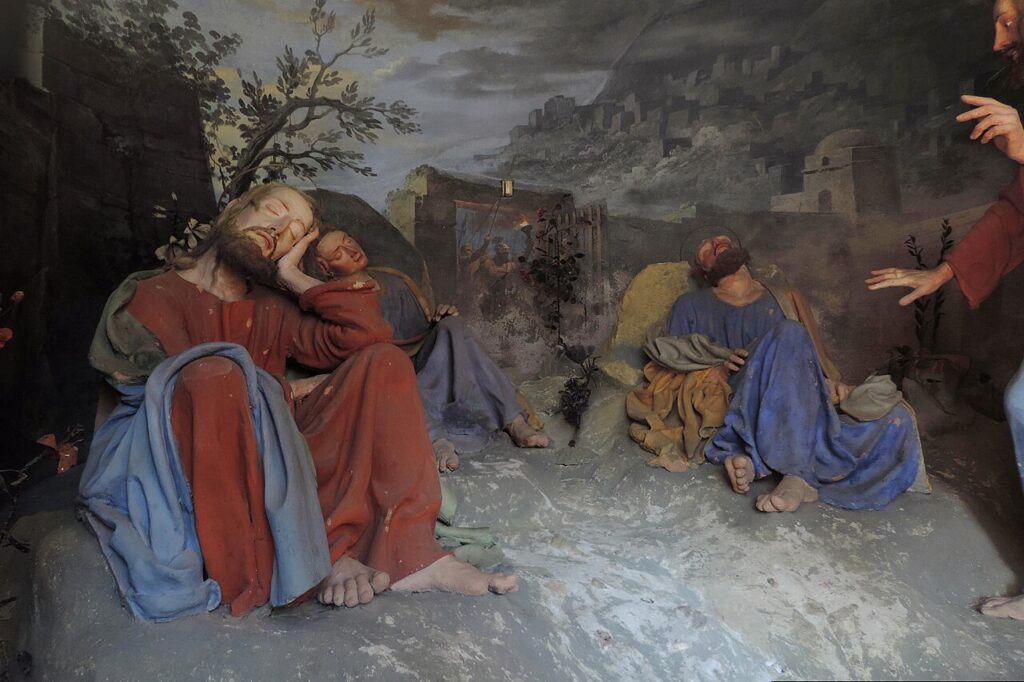
Cappella 22: Gesu’ Sveglia i Discepoli Dormienti‎, Sacro Monte di Varallo Sesia, Piedmont, Italy. https://commons.wikimedia.org/wiki/File:Varallo_Sesia,Sacro_MonteChapel_22-_Jesus_Awakens_the_Sleeping_Disciples_001.jpg

Our reading for Maundy Thursday is Mark 14:32–42. The warmth and memory of the Upper Room were behind Jesus now. The bread, the wine, the final words of love spoken over his closest friends — all of it faded as Jesus stepped into the cold darkness of the garden of Gethsemane. With the city asleep and the shadows deep, the Son of God faced the loneliest moment in human history.
He brought his three closest disciples — Peter, James, and John — and asked one thing of them: “Remain here, and keep awake” (Mark 14: 36). But they slept. In his hour of greatest need, the people he loved most could not stay awake. Jesus was left to wrestle alone.
And wrestle he did. The Gospel writers search for words to describe what happened next in Gethsemane, and even their most powerful language falls short in conveying what he went through. He was “distressed and agitated,” “grieved and agitated,” “greatly distressed and troubled,” “deeply distressed and horrified,” “sore amazed, and to be very heavy,” “deeply grieved,” “exceedingly sorrowful, even to death.”
This was not mild anxiety. This was a soul bearing the full weight of human sin, facing a cross no human heart was ever designed to carry.
And so he prayed — not with polished theological language, but with raw, desperate honesty: “Abba, Father, for you all things are possible; remove this cup from me” (Mark 14:36).
This is one of the most important prayers in all of Scripture, because Jesus shows us something we often forget: authentic prayer is not the absence of fear. It is the presence of honesty. He did not pretend or perform. He brought his deepest fears directly to the Father, and he asked — plainly, urgently — for another way.
The Father did not remove the cup. Yet he did not leave his Son alone either. An angel appeared to strengthen him. And here is the truth that changes everything: the Father’s “No” to escape was a “Yes” to endurance. God did not take away the suffering — he gave Jesus the strength to walk through it.
And then came the pivot point of all history: “yet not what I want but what you want.”
In His sufferings, Jesus did not bypass his humanity — he walked through it completely. He surrendered his will to the Father’s, trusting that the path of suffering was not the end of the story. This is why, three days later, the garden of agony became the garden of resurrection.
Perhaps you are in your own Gethsemane right now. A diagnosis. A broken relationship. A door that will not open no matter how hard you knock. You have prayed — sincerely, repeatedly — and the answer feels like silence, or worse, a quiet and resolute “No.”
Bring it to the Father anyway. Ask honestly. Ask urgently, as Jesus did. And if the cup does not pass, if healing does not happen, trust that the same God who strengthened his Son in the garden will strengthen you. Your pain is not a sign that God has abandoned you. It is the very place where he meets you.
And remember the sleeping disciples. When someone you love is in their Gethsemane, do not fall asleep on them. Stay present. Sit in the dark with them. Sometimes the most Christlike thing we can do is simply refuse to leave our friends.


What is the cup you are afraid to drink today? Can you bring it — honestly, without pretending — to the Father, and ask him not just to remove it, but to give you the strength to face it?

Leave a Comment

The Temple Courtyard Was Full of Noise, But Empty of Prayer

Enrique Simonet, Public domain, https://commons.wikimedia.org/wiki/File:Simonet_-_expulsion_mercaderes.jpg

In Mark 11: 15-19 we read that as Jesus rode into Jerusalem for Passover; the city buzzed with anticipation. Families were scrubbing their homes, removing every crumb of yeast in honor of their liberation from Egypt. It was a season of intense spiritual preparation. Yet when Jesus entered the Temple — the one place where God’s presence was meant to dwell — he found something deeply troubling.

Instead of sanctity and sincere prayer, the air was thick with the bleating of lambs, the clinking of coins, and the smell of animals. The Court of the Gentiles — the only space in the entire Temple complex where non-Jews could come to seek God — had been transformed into a bustling marketplace. This was not merely a case of greed hiding behind religion. The deeper wound that troubled Jesus was exclusion.

By design, this outer court was meant to be a sanctuary for “foreigners coming from a distant land, so that all the peoples of the earth may know God’s name” (2 Chronicles 6:32–33). But the religious leaders had turned it into a religious flea market. The noise of commerce had drowned out the whispers of prayer, and the very people the prophets promised (Isaiah 56:7) God would gather had been excluded.

Jesus responded with righteous indignation. He drove out the animals with a whip, overturned the tables, and declared: “Is it not written, ‘My house shall be called a house of prayer for all the nations’? But you have made it a den of robbers” (Mark 11:17). He was not angry at the need for sacrifice or currency exchange. He was furious that the system had become a barrier — that the religious elite had built a wall where a door should have been.

This story forces us to look honestly at our own temples — our sanctuaries, our denominations, our theologies, our churches, and our communities.

We don’t need to sell doves or lambs to block people from God today. We do it by making our spaces so program-heavy and internally focused that there is no room left for the seeker. We do it when our budgets, buildings, and business efficiency matter more than the mission of God. We do it whenever the outsider — the skeptic, the refugee, the broken, the one who doesn’t look or think like us, those who do not fit our mold — feels unwelcome or unheard.

In cleansing the temple, Jesus proclaimed that he came not just to fix a building, but to restore access to God. And ultimately, he pointed to himself as the true Temple. On the cross, the veil was torn and the barrier destroyed forever: “He is our peace; in his flesh he has broken down the dividing wall, the hostility between us” (Ephesians 2:14).

Today, Jesus invites us to let him search our beliefs, hearts and our churches — to clear out the noise of self-importance and make room again for the outsider.

Who is the “Gentile” or the “other” in your life right now—the person who feels on the outside looking in? How can you make space for them to pray, to be heard, and to belong?

Leave a Comment

Rejected Every Day — He Kept Loving Anyway

Most of us picture Jesus’ suffering as concentrated into two defining moments — the forty days of temptation in the wilderness, and the final agonizing hours on the cross. But a closer reading of the Gospels reveals something more painful and more personal: rejection was not an exception in Jesus’ life. It was the atmosphere he breathed, from the very beginning to the very end.

It started at birth. Before he could walk or speak, he was already unwanted — a refugee infant carried by desperate parents into a foreign land, fleeing a king who wanted him dead. He grew up displaced, returning to Galilee as a stranger in his own homeland. And it never really got easier.

In Mark 10: 13-16, his own disciples — the men he had personally chosen and poured himself into — tried to turn children away from him. Not strangers. Not enemies. His closest friends from Galilee! Jesus was so troubled by this that the text says he was “indignant.” The very people entrusted with his message were the ones most likely to miss its point.

On the road to Jerusalem, an entire Samaritan village rejected him and didn’t want to have anything with Jesus. His disciples, James and John, were furious and asked Jesus to call down fire from heaven on the village. Jesus rebuked them. Not because he lacked the power, but because his mission was never destruction — it was always redemption.

And then there was Judas. A man who had sat at his table, heard his teaching, and witnessed his miracles — who sold him for the price of a common slave.

So how did Jesus survive it — not just the cross, but a lifetime of rejection?

His identity was not built on the approval of people. It was anchored in something no one could take from him — the voice of the Father, who had spoken over him at his baptism: “You are my beloved Son.”  When the crowds called him a drunkard, a madman, demon-possessed, he did not crumble. He knew who he was because the Father had already said so.

And because his identity was secure, rejection could not control his behavior. He didn’t lash out at the disciples who kept getting it wrong. He didn’t curse the village that turned him away. He didn’t become bitter toward Judas. He absorbed the pain — and responded with love anyway.

This is where the story becomes personal.

Most of us handle rejection by building walls, going quiet, or nursing a wound until it hardens into bitterness. Jesus invites us into something harder and more beautiful: to love the people who have hurt us, not because they deserve it, but because we have been loved the same way.

He was rejected so that you could be accepted. He carried the world’s hostility so you would not have to carry it alone.

Who is the person in your life right now who has rejected you? Who is your Samaritan? Who is your Judas? What would it look like today — not someday, but today — to choose love instead of bitterness, trusting that your worth is secured not by their opinion, but by what God the Father thinks and says about you.

Leave a Comment

Lenten Reflections 2021: What does Following Jesus Have to do with Racism?

Credit Jansel Ferma at Pexels

 @johnvinod | March 22, 2021

In an unending series of racial violence and hate crimes, the latest to break our hearts is a young Christian man in Georgia, USA, last week. He went on a killing spree, especially targeting Asian women. One of his victims was a single mother of South Korean descent, Hyun Jung Grant, who was raising two young boys working hard in a spa. As the followers of Christ, we cannot overlook this when members of our own families and churches pick up guns and go around destroying innocent families and leaving young orphans in its aftermath. Let us, therefore, read today Luke 10: 25-37.

One of the reasons, racial violence and hate crimes go on unabated in the majority Christian countries, targeting people of color, is because our churches have not been bold enough to teach or preach on the issues of racism and ethnocentrism. Not just churches, but it is rare to find among the luminaries of western theologians, in the past centuries, who have included the issues of racism or colonialism in their theological treatises. The reason is simple: it was not an issue they had to deal with.

However, reading the gospels, we come across Jesus who was born, raised, and ministered during the Roman colonization of Israel. Even within Israel, he was aware of the racial intolerance among the Jews, the Gentiles, and the Samaritans. Therefore, Jesus made it his business to address the issue of racial discrimination and hatred throughout his ministry. One such teaching is in today’s text in Luke 10: 25-37. It is a familiar parable of Jesus found only in Luke’s gospel. Everything in his story was going normal until Jesus introduced a Samaritan. The lawyer who was testing him, Jesus’ disciples, and the those who were listening in were all Jewish people and they did not anticipate that Jesus, being a Jewish guru, would show the Samaritan in the limelight as he did.

Imagine the predicament of the lawyer. He had to answer Jesus’ probing question after listening to the shocking parable of the Samaritan who showed compassion and mercy to the Jewish man, he had found laying wounded on the side of the road. The lawyer knew the honest answer to Jesus’s question, “Which of these three, do you think, proved to be a neighbor to the man who fell among the robbers?” (Luke 10: 36). However, he could not bring himself up to openly say, “the Samaritan”! His prejudices of the Samaritan people would not permit him to agree with Jesus’ proposition that a Samaritan would demonstrate how to value human life in need, irrespective his ethnic differences with the needy. He did not expect the Samaritan man to come out as the hero of the story because he had always stereotyped them as evil and unclean people who would never do good for the Jewish people. It was Jesus’ purpose to shatter such prejudices and stereotypes about the other.

Jesus dumbfounded not only the lawyer, but each of us today who reads this story by saying, “You go, and do likewise” (Luke 10:37 ESV). This parable forces listeners to decide what they should be doing. Do like the Samaritan, not like what your own people are doing. The lawyer had asked Jesus what he should do, Jesus told him exactly what to do, i.e., get in the habit of demonstrating your mercy like the Samaritan did for the needy and wounded people on the margins of your busy life. Permit such people often to interrupt and pause our schedules and business as usual rut. So that we may reach out to them to be good neighbors irrespective of their color of skin, physical appearance, social status, or ethnic background.

To “what must I do,” even today Jesus replies: “Go, and do likewise,” as the Samaritan man did. May we choose to follow Jesus Christ.


For a paperback, please send a message using the contact us form.
Leave a Comment

Lenten Reflections 2021: Return to the Lord!

Locust invasion

Rev. Dr. Vinod John @johnvinod | February 18, 2021

I would invite you today to read again the tiny book of Joel in one sitting as it has only three chapters. The message of the book of Joel is never passé. In fact, Joel’s message has relevance for the whole world today more than ever no matter where you live. It is expressly because Joel’s context and ours are quite similar today. In Joel’s time, Israel went through a devastating plague—an invasion of devouring locusts. They had eaten and destroyed everything in their way and turned the green pastures of Israel to desolate. The food supply was almost destroyed, and people were crying out for help.

 “The seed is rotten under their clods, the garners are laid desolate, the barns are broken down; for the corn is withered.
 How do the beasts groan!
 the herds of cattle are perplexed, because they have no pasture; yea, the flocks of sheep are made desolate” (Joel 1: 18 KJV). 

Moreover, the liturgical worship of God in the Temple was also adversely affected to the extent that its daily offerings had almost diminished:

 “The grain offering and the drink offering are cut off from the house of the Lord. The priests mourn, the ministers of the Lord” …
 “Put on sackcloth and lament, you priests; wail, you ministers of the altar.
Come, pass the night in sackcloth, you ministers of my God!
Grain offering and drink offering are withheld from the house of your God” (Joel 1: 9; 13 NRSV) 

We are in the second year of an unprecedented and deadly pandemic since 2020 and there seems to be no end in site, despite the new vaccines that might help prevent Covid-19 infections. The world economies are faltering and will remain unstable in the aftermath of this pandemic. Therefore, I think we need to heed prophet Joel’s timely call to repentance. While prophesying in the context of a dreadful plague of locusts that affected all aspects of their life, including the religious worship, Joel pleads with Israel to return to the Lord. He preaches a message of hope. He reveals the nature and intent of God, that is not to destroy the people of Israel but to save them. If they repented of their disobedience and returned from their evil ways to the living God, Joel promises that God would pity them and restore them. Joel also reveals that in a post repentance and restoration era, God would bring about a new reality, that is, the Spirit of God abiding with them (see, Joel 2: 28-29). We shall ponder on this aspect in the coming days along with Joel’s apocalyptic predictions.

However, today, let us shift our focus from the death, loss, and destruction brought about by the pandemic that we find ourselves in and instead let us focus upon the areas in our lives that need amending. What specific areas in our personal and church life do we need to do penitence? What are the specific areas in which we need to turn back from disobedience to obedience? May the Lord help us locate these areas and let us return to the Lord seeking His grace and forgiveness for our Creator God is merciful and will restore us.

In our churches, what we loved the most—our in-person corporate worship and fellowship—have been curtailed by this evil pandemic. However, let us use this time to reflect upon our church life and its sins, disobedience, and complicity. How has our church been doing in the midst of racism, sexism, bigotry, sectarianism, favoritism, ethnocentricity, preferentialism, xenophobia, discrimination, immorality, dogmatism, celebrity worship, false saviors, and several other areas that this Lent season may reveal to us? Perhaps, you do not see this visibly in your church, but has your church been apathetic to these issues and their presence in and around the church? If so, may we heed the call of Joel who called the Temple priests, too, to repentance:

"Put on sackcloth and lament, you priests; wail, you ministers of the altar.
Come, pass the night in sackcloth, you ministers of my God!" (Joel 1:13 NRSV).
“Let the priests, the ministers of the Lord, weep between the porch and the altar, and let them say, Spare thy people, O Lord, …” (Joel 2: 17 KJV).

For a paperback, please contact vinod@vinodjohn.com

2 Comments

Lenten Reflections 2021: What is Lent and Why I like the Lenten Season?

By Rev. Dr. Vinod John @johnvinod
Ash Wednesday | February 17, 2021

The word “Lent” emerged as an abbreviation of an old English term, “Lencten” meaning lengthening of days and pointing to the onset of the much-awaited springtime or spring season after a long and cold winter in Europe. The Lent or the passion season is one of the most beautiful times of the year. I like it more than the Christmas season for several reasons.

First, though the birth of Jesus Christ was unique in several ways; however, his birth and the three decades that Jesus spent after his birth living almost in anonymity in Galilee of Israel would not have mattered much if he had not launched into the divine ministry for which he came.

Second, I like the Lenten season better than Christmas because Lent is yet uncommercialized and has not yet lost its spiritual meaning like Christmas.

Third, Lent has not become as popular as the Christmas season and only the spiritually inclined followers of Christ still show some interest in the disciplines associated with the Lenten Season such as prayer, fasting, sacrifice, and giving up certain things we love most to gain something higher and deeper.

Fourth, Lenten season commemorates literally the forty days of Jesus’ experiences and struggles in the wilderness, unlike Christmas and its traditions, which hardly have anything to do with the reality of what truly happened at the birth of Jesus Christ. In fact, no one knows exactly when Jesus was born…certainly not on December 25th!

Fifth, I admire how the Lenten season is about looking within and deeper into ourselves and it is an opportunity for us to learn and draw from the deep spirituality of Jesus Christ rather than looking outside at the pompous celebrations, opulent festivities, and show-off of what money and power can buy during the Christmas season.

Sixth, I like how the Lenten season begins and how it concludes. It is the Lent—the forty days of physical and spiritual solitude in the wilderness—that ushered Jesus Christ into this divine calling and ministry. This sacred season in the church tradition today culminates in a requisite reminder of the glorious resurrection of our Lord Jesus Christ, especially in the context we find ourselves in since 2020.

Seventh, I also love the Lenten season, because it follows an ancient tradition of the early Christianity in which the followers of Jesus were prepared and discipled before they were baptized on Easter Sunday. This Lenten season, therefore, is another opportunity for us to examine our lives and ask ourselves if it is really the biblical Jesus Christ we are following or the Jesus of own making as per our own culture or religion.

Eighth, and lastly, I appreciate the Lenten Season because it affords us the unique opportunity to take our eyes off everything else and focus on Jesus Christ, our Lord and Savior. This is particularly true in the current pandemic caused by the Covid-19 virus which has claimed millions of lives around the world, crippling economies of all nations, siphoning off lives of most people and churches and leaving many of us literally and figuratively gasping for a fresh breath of hope. The lent/springtime is a time of hope. And what better hope can we think of than the fact of the resurrection of our Lord Jesus Christ in time of death and destruction that we see around us today? What better hope than the hope of a bodily resurrection of our loved ones who we have lost in the past year or so? What better hope can there be than this that we, too, shall be resurrected to eternal life even if we departed from this earth during this pandemic in 2021?

Therefore, I invite you to journey with me in this current season of Lent 2021 with much expectation, “looking to Jesus the pioneer and perfecter of our faith, who for the sake of the joy that was set before him endured the cross, disregarding its shame, and has taken his seat at the right hand of the throne of God” (Hebrews 12: 2 NRSV). And as we focus on Him this Ash Wednesday, February 17th, the first day of the Lenten season of 2021, let us sincerely heed to the earnest plea of prophet Joel in the Old Testament and let us return to the Lord!

“Yet even now,” declares the Lord, return to me with all your heart,

with fasting, with weeping, and with mourning; and rend your hearts and not your garments.”

Return to the Lord your God, for he is gracious and merciful, slow to anger, and abounding in steadfast love; and he relents over disaster” (Joel 2: 12-13 ESV).


For a paperback, please contact vinod@vinodjohn.com

6 Comments

You have successfully subscribed to our blog. Thank you!

There was an error while trying to send your request. Please try again.

You agree to receive posts and updates from this site through the above email Id.