Skip to content

Category: Holy Week

When God Seems Absent: A Silent Saturday Reflection

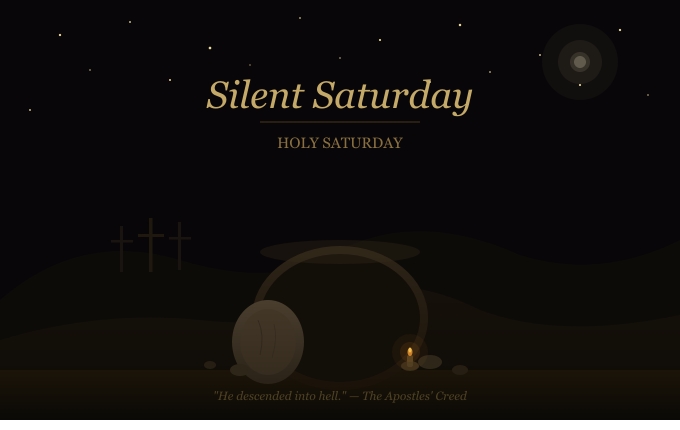
Today marks the final day of the Lenten journey — Holy Saturday, often called Silent Saturday — a day of rest and preparation for the Resurrection. And yet, for all its weight, nobody quite knows what to do with it.


Good Friday has its gravity—the cross, the darkness, the cry of dereliction. Easter has its trumpets. But the day in between just sits there, quiet and strange. The altars are bare. There is no Eucharist, no alleluias. In the old liturgical rhythm, not even a candle is lit. It is the one day of the Church year when the world is simply asked to wait—and waiting, as most of us know, is its own kind of suffering.

Jesus’ disciples certainly found it so. They scattered. They hid. Whatever they had hoped Jesus was, it seemed finished.

But the oldest Christian confession dares to say otherwise. The Apostles’ Creed, in its spare and careful language, declares that after His death, Christ “descended into hell.” Certain Christians anchor this in specific texts, such as, 1 Peter 3:18–20, Ephesians 4:8–9, Acts 2:27, and Matthew 12:40.


However, the original Latin word is inferos, meaning the realm of the dead. The Greek and Hebrew terms, Hades and Sheol, also mean the common realm where human souls go when they leave the body. Therefore, in the Creed, “hell” is not the place of final punishment, but the realm of the dead—the place every human goes. Christ went there because He went everywhere humans go. Jesus did not sidestep death or hover above it. He entered it—all the way in, just as He entered everything else about our condition.


What happened there is where different Christian traditions diverge—and they do so honestly. Eastern Orthodox have long treasured an icon of Christ standing on the splintered gates of Hades, reaching down to pull Adam and Eve out of the dark—a picture of Easter that begins before the stone ever rolls away. Medieval theologians spoke of the righteous dead, the patriarchs and prophets, finally receiving what they had only seen from a distance. Calvin argued the “descent” was not a journey at all but the depth of spiritual suffering Christ endured on the cross—the hell He absorbed so we would not have to bear it. Still other scholars read 1 Peter 3 as Christ declaring His victory to fallen spiritual powers — a proclamation not of mercy but of conquest.


The honest answer is that Scripture leaves this in partial shadow. And perhaps that is fitting. Holy Saturday is, by its nature, the day we cannot fully see into.

What we can say is this: the silence was not emptiness. Wherever Christ was on that Saturday, He was not a victim waiting to be rescued. He was moving through death with the same intention He brought to everything—purposeful, sovereign, undefeated even in the grave.


That matters for more than theology. Most of us know what it is to live in a Saturday season—after something has broken, before anything has been restored. The prayer that hasn’t been answered. The diagnosis that changed everything. The relationship that ended without resolution. The long, grinding wait when Friday’s wound is still fresh and Sunday feels like a rumor.


Holy/ Silent Saturday does not offer cheap comfort. It does not rush you toward the resurrection or tell you to cheer up. What it offers is something stranger—and more solid—than that: the assurance that Christ has already been into the darkest place you’re facing. He didn’t send a message from outside it. He went in. He holds, as He told John, the keys of death and Hades. He didn’t borrow them. He took them.

So, sit in the stillness today if you need to. Name the things that feel sealed and cold. And remember—the silence outside the tomb was not the silence of a story ending. It was the silence before a door flew open from the inside.
He is already there.
The stone will move.
Leave a Comment

Paid in Full: What Jesus Finished on the Cross

On Good Friday, churches traditionally reflect on the seven “words” of Christ from the cross. While we cannot know exactly how many times Jesus spoke or the precise sequence of his final moments, the Gospel writers have preserved these seven declarations for us. In the churches I have served, it is customary to invite laypeople to speak on these words during the service. Every time I assign them, I face a familiar challenge: everyone has a favorite.

I suspect you do, too. Perhaps it is “Father, forgive them” or “Today you will be with me in Paradise.” But my favorite — the one that haunts and comforts me most — is the final declaration found only in John’s Gospel: “It is finished.”

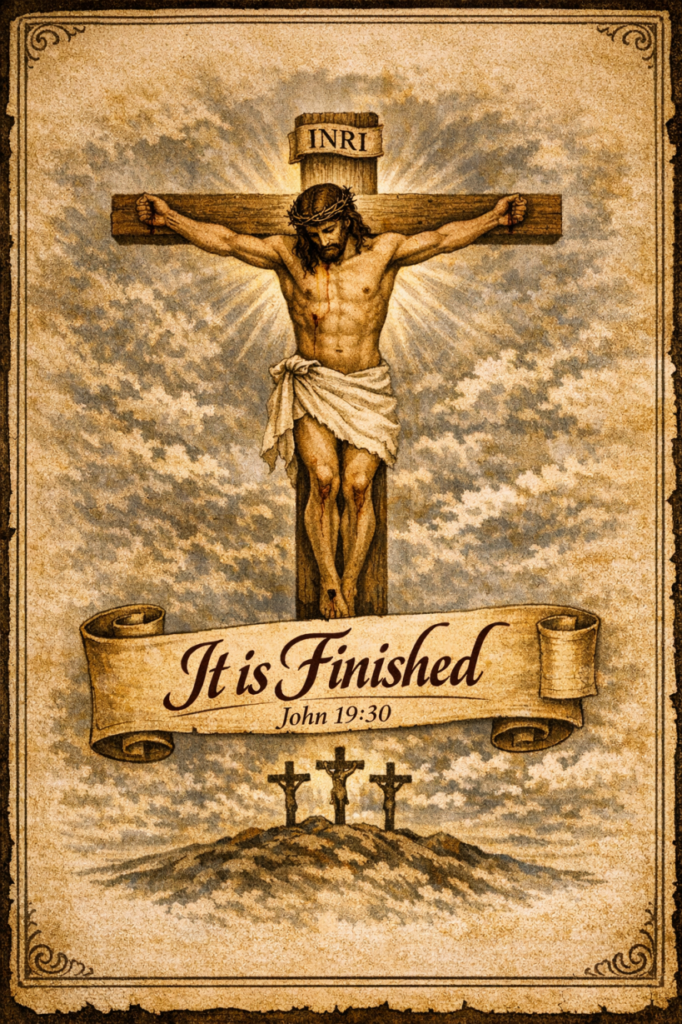
“When Jesus had received the wine, he said, ‘It is finished.’ Then he bowed his head and gave up his spirit” (John 19:30).

In the original Greek, this phrase is “tetelestai.” The root word, teleo, means “to accomplish,” “finish,” “end,” or “to bring to its intended goal.” Thus, tetelestai carries the weight of “consummated,” “completed,” or “paid in full.” In the first century, this term was stamped on business receipts to indicate a debt had been settled completely.

To me, these three words are among the most profound Jesus ever spoke. No one has ever spoken words richer with spiritual and theological meaning. Their depth is staggering; no human mind can fully fathom the totality of what Jesus meant in that final breath. Yet this declaration stands as the culmination of all human effort to please God and the zenith of God’s work for our salvation.

In this single Greek word tetelestai, the scope of redemption expands infinitely. God’s purpose for the world is fully actualized. Every prophetic utterance of the holy men and women of old finds its “yes” in Christ. All of Jesus’ claims and “I am” statements are confirmed. The long-held aspirations of humanity through the ages are realized. Forgiveness of sins is no longer a hope but a completed reality. The healing of nations and individuals is secured — “by his wounds we are healed” (Isaiah 53:5). The triumph over every enemy is achieved, with death itself as the final foe to be destroyed (1 Corinthians 15:26). And the final redemption of humanity is accomplished (John 3:16).

The list could go on, but the point remains: it is finished. The work is done. The debt is paid.

This is not just a historical event; it is a present reality. We are invited to stop striving and start resting in this accomplishment. Let us not only receive this truth personally but also share it with those who do not yet know the power of a finished work.

. . .

Reflection: Which of these truths do you need to cling to most today? How does the knowledge that the work of your salvation is finished change the way you approach your struggles?

Leave a Comment

When the Answer to Your Prayer Is No: Finding God in Your Gethsemane

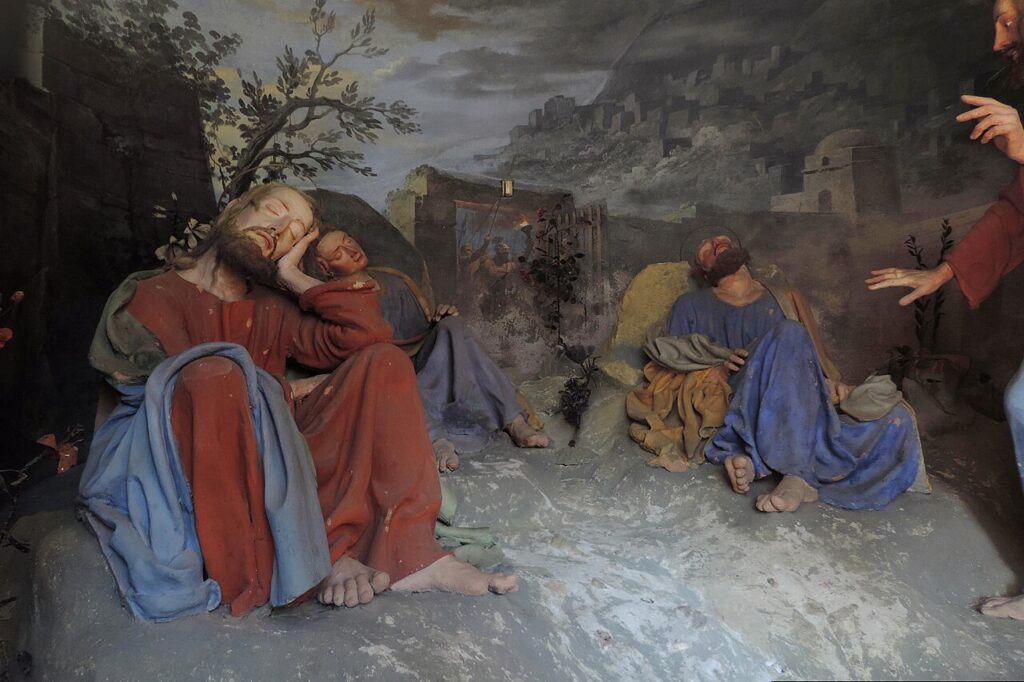
Cappella 22: Gesu’ Sveglia i Discepoli Dormienti‎, Sacro Monte di Varallo Sesia, Piedmont, Italy. https://commons.wikimedia.org/wiki/File:Varallo_Sesia,Sacro_MonteChapel_22-_Jesus_Awakens_the_Sleeping_Disciples_001.jpg

Our reading for Maundy Thursday is Mark 14:32–42. The warmth and memory of the Upper Room were behind Jesus now. The bread, the wine, the final words of love spoken over his closest friends — all of it faded as Jesus stepped into the cold darkness of the garden of Gethsemane. With the city asleep and the shadows deep, the Son of God faced the loneliest moment in human history.
He brought his three closest disciples — Peter, James, and John — and asked one thing of them: “Remain here, and keep awake” (Mark 14: 36). But they slept. In his hour of greatest need, the people he loved most could not stay awake. Jesus was left to wrestle alone.
And wrestle he did. The Gospel writers search for words to describe what happened next in Gethsemane, and even their most powerful language falls short in conveying what he went through. He was “distressed and agitated,” “grieved and agitated,” “greatly distressed and troubled,” “deeply distressed and horrified,” “sore amazed, and to be very heavy,” “deeply grieved,” “exceedingly sorrowful, even to death.”
This was not mild anxiety. This was a soul bearing the full weight of human sin, facing a cross no human heart was ever designed to carry.
And so he prayed — not with polished theological language, but with raw, desperate honesty: “Abba, Father, for you all things are possible; remove this cup from me” (Mark 14:36).
This is one of the most important prayers in all of Scripture, because Jesus shows us something we often forget: authentic prayer is not the absence of fear. It is the presence of honesty. He did not pretend or perform. He brought his deepest fears directly to the Father, and he asked — plainly, urgently — for another way.
The Father did not remove the cup. Yet he did not leave his Son alone either. An angel appeared to strengthen him. And here is the truth that changes everything: the Father’s “No” to escape was a “Yes” to endurance. God did not take away the suffering — he gave Jesus the strength to walk through it.
And then came the pivot point of all history: “yet not what I want but what you want.”
In His sufferings, Jesus did not bypass his humanity — he walked through it completely. He surrendered his will to the Father’s, trusting that the path of suffering was not the end of the story. This is why, three days later, the garden of agony became the garden of resurrection.
Perhaps you are in your own Gethsemane right now. A diagnosis. A broken relationship. A door that will not open no matter how hard you knock. You have prayed — sincerely, repeatedly — and the answer feels like silence, or worse, a quiet and resolute “No.”
Bring it to the Father anyway. Ask honestly. Ask urgently, as Jesus did. And if the cup does not pass, if healing does not happen, trust that the same God who strengthened his Son in the garden will strengthen you. Your pain is not a sign that God has abandoned you. It is the very place where he meets you.
And remember the sleeping disciples. When someone you love is in their Gethsemane, do not fall asleep on them. Stay present. Sit in the dark with them. Sometimes the most Christlike thing we can do is simply refuse to leave our friends.


What is the cup you are afraid to drink today? Can you bring it — honestly, without pretending — to the Father, and ask him not just to remove it, but to give you the strength to face it?

Leave a Comment

The Temple Courtyard Was Full of Noise, But Empty of Prayer

Enrique Simonet, Public domain, https://commons.wikimedia.org/wiki/File:Simonet_-_expulsion_mercaderes.jpg

In Mark 11: 15-19 we read that as Jesus rode into Jerusalem for Passover; the city buzzed with anticipation. Families were scrubbing their homes, removing every crumb of yeast in honor of their liberation from Egypt. It was a season of intense spiritual preparation. Yet when Jesus entered the Temple — the one place where God’s presence was meant to dwell — he found something deeply troubling.

Instead of sanctity and sincere prayer, the air was thick with the bleating of lambs, the clinking of coins, and the smell of animals. The Court of the Gentiles — the only space in the entire Temple complex where non-Jews could come to seek God — had been transformed into a bustling marketplace. This was not merely a case of greed hiding behind religion. The deeper wound that troubled Jesus was exclusion.

By design, this outer court was meant to be a sanctuary for “foreigners coming from a distant land, so that all the peoples of the earth may know God’s name” (2 Chronicles 6:32–33). But the religious leaders had turned it into a religious flea market. The noise of commerce had drowned out the whispers of prayer, and the very people the prophets promised (Isaiah 56:7) God would gather had been excluded.

Jesus responded with righteous indignation. He drove out the animals with a whip, overturned the tables, and declared: “Is it not written, ‘My house shall be called a house of prayer for all the nations’? But you have made it a den of robbers” (Mark 11:17). He was not angry at the need for sacrifice or currency exchange. He was furious that the system had become a barrier — that the religious elite had built a wall where a door should have been.

This story forces us to look honestly at our own temples — our sanctuaries, our denominations, our theologies, our churches, and our communities.

We don’t need to sell doves or lambs to block people from God today. We do it by making our spaces so program-heavy and internally focused that there is no room left for the seeker. We do it when our budgets, buildings, and business efficiency matter more than the mission of God. We do it whenever the outsider — the skeptic, the refugee, the broken, the one who doesn’t look or think like us, those who do not fit our mold — feels unwelcome or unheard.

In cleansing the temple, Jesus proclaimed that he came not just to fix a building, but to restore access to God. And ultimately, he pointed to himself as the true Temple. On the cross, the veil was torn and the barrier destroyed forever: “He is our peace; in his flesh he has broken down the dividing wall, the hostility between us” (Ephesians 2:14).

Today, Jesus invites us to let him search our beliefs, hearts and our churches — to clear out the noise of self-importance and make room again for the outsider.

Who is the “Gentile” or the “other” in your life right now—the person who feels on the outside looking in? How can you make space for them to pray, to be heard, and to belong?

Leave a Comment

Rejected Every Day — He Kept Loving Anyway

Most of us picture Jesus’ suffering as concentrated into two defining moments — the forty days of temptation in the wilderness, and the final agonizing hours on the cross. But a closer reading of the Gospels reveals something more painful and more personal: rejection was not an exception in Jesus’ life. It was the atmosphere he breathed, from the very beginning to the very end.

It started at birth. Before he could walk or speak, he was already unwanted — a refugee infant carried by desperate parents into a foreign land, fleeing a king who wanted him dead. He grew up displaced, returning to Galilee as a stranger in his own homeland. And it never really got easier.

In Mark 10: 13-16, his own disciples — the men he had personally chosen and poured himself into — tried to turn children away from him. Not strangers. Not enemies. His closest friends from Galilee! Jesus was so troubled by this that the text says he was “indignant.” The very people entrusted with his message were the ones most likely to miss its point.

On the road to Jerusalem, an entire Samaritan village rejected him and didn’t want to have anything with Jesus. His disciples, James and John, were furious and asked Jesus to call down fire from heaven on the village. Jesus rebuked them. Not because he lacked the power, but because his mission was never destruction — it was always redemption.

And then there was Judas. A man who had sat at his table, heard his teaching, and witnessed his miracles — who sold him for the price of a common slave.

So how did Jesus survive it — not just the cross, but a lifetime of rejection?

His identity was not built on the approval of people. It was anchored in something no one could take from him — the voice of the Father, who had spoken over him at his baptism: “You are my beloved Son.”  When the crowds called him a drunkard, a madman, demon-possessed, he did not crumble. He knew who he was because the Father had already said so.

And because his identity was secure, rejection could not control his behavior. He didn’t lash out at the disciples who kept getting it wrong. He didn’t curse the village that turned him away. He didn’t become bitter toward Judas. He absorbed the pain — and responded with love anyway.

This is where the story becomes personal.

Most of us handle rejection by building walls, going quiet, or nursing a wound until it hardens into bitterness. Jesus invites us into something harder and more beautiful: to love the people who have hurt us, not because they deserve it, but because we have been loved the same way.

He was rejected so that you could be accepted. He carried the world’s hostility so you would not have to carry it alone.

Who is the person in your life right now who has rejected you? Who is your Samaritan? Who is your Judas? What would it look like today — not someday, but today — to choose love instead of bitterness, trusting that your worth is secured not by their opinion, but by what God the Father thinks and says about you.

Leave a Comment

You have successfully subscribed to our blog. Thank you!

There was an error while trying to send your request. Please try again.

You agree to receive posts and updates from this site through the above email Id.