Skip to content

Category: Maundy Thursday

When the Answer to Your Prayer Is No: Finding God in Your Gethsemane

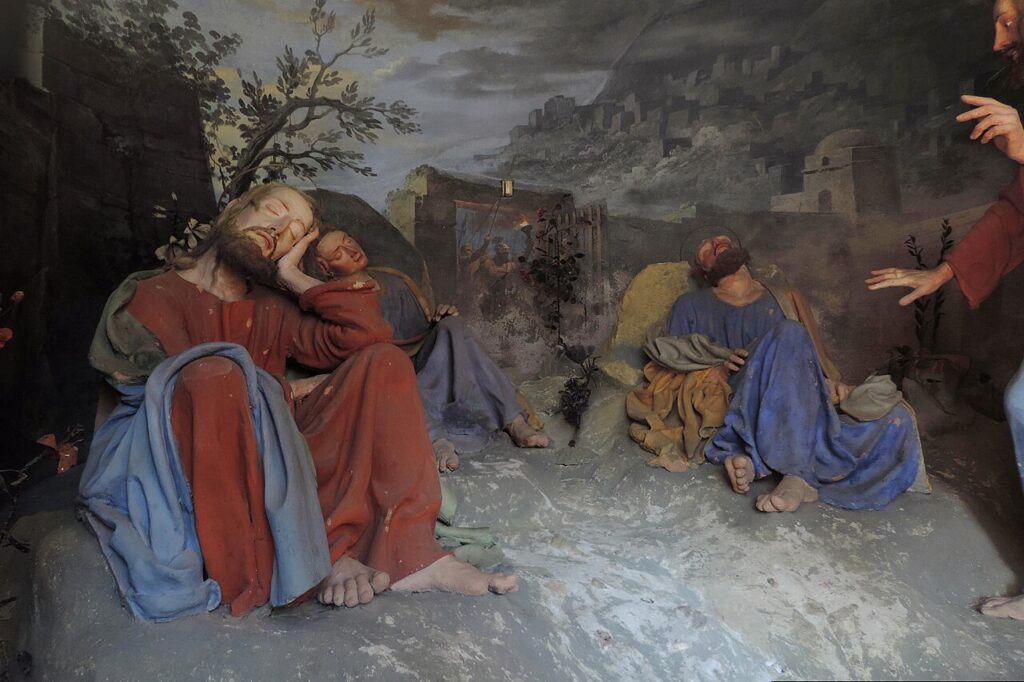
Cappella 22: Gesu’ Sveglia i Discepoli Dormienti‎, Sacro Monte di Varallo Sesia, Piedmont, Italy. https://commons.wikimedia.org/wiki/File:Varallo_Sesia,Sacro_MonteChapel_22-_Jesus_Awakens_the_Sleeping_Disciples_001.jpg

Our reading for Maundy Thursday is Mark 14:32–42. The warmth and memory of the Upper Room were behind Jesus now. The bread, the wine, the final words of love spoken over his closest friends — all of it faded as Jesus stepped into the cold darkness of the garden of Gethsemane. With the city asleep and the shadows deep, the Son of God faced the loneliest moment in human history.
He brought his three closest disciples — Peter, James, and John — and asked one thing of them: “Remain here, and keep awake” (Mark 14: 36). But they slept. In his hour of greatest need, the people he loved most could not stay awake. Jesus was left to wrestle alone.
And wrestle he did. The Gospel writers search for words to describe what happened next in Gethsemane, and even their most powerful language falls short in conveying what he went through. He was “distressed and agitated,” “grieved and agitated,” “greatly distressed and troubled,” “deeply distressed and horrified,” “sore amazed, and to be very heavy,” “deeply grieved,” “exceedingly sorrowful, even to death.”
This was not mild anxiety. This was a soul bearing the full weight of human sin, facing a cross no human heart was ever designed to carry.
And so he prayed — not with polished theological language, but with raw, desperate honesty: “Abba, Father, for you all things are possible; remove this cup from me” (Mark 14:36).
This is one of the most important prayers in all of Scripture, because Jesus shows us something we often forget: authentic prayer is not the absence of fear. It is the presence of honesty. He did not pretend or perform. He brought his deepest fears directly to the Father, and he asked — plainly, urgently — for another way.
The Father did not remove the cup. Yet he did not leave his Son alone either. An angel appeared to strengthen him. And here is the truth that changes everything: the Father’s “No” to escape was a “Yes” to endurance. God did not take away the suffering — he gave Jesus the strength to walk through it.
And then came the pivot point of all history: “yet not what I want but what you want.”
In His sufferings, Jesus did not bypass his humanity — he walked through it completely. He surrendered his will to the Father’s, trusting that the path of suffering was not the end of the story. This is why, three days later, the garden of agony became the garden of resurrection.
Perhaps you are in your own Gethsemane right now. A diagnosis. A broken relationship. A door that will not open no matter how hard you knock. You have prayed — sincerely, repeatedly — and the answer feels like silence, or worse, a quiet and resolute “No.”
Bring it to the Father anyway. Ask honestly. Ask urgently, as Jesus did. And if the cup does not pass, if healing does not happen, trust that the same God who strengthened his Son in the garden will strengthen you. Your pain is not a sign that God has abandoned you. It is the very place where he meets you.
And remember the sleeping disciples. When someone you love is in their Gethsemane, do not fall asleep on them. Stay present. Sit in the dark with them. Sometimes the most Christlike thing we can do is simply refuse to leave our friends.


What is the cup you are afraid to drink today? Can you bring it — honestly, without pretending — to the Father, and ask him not just to remove it, but to give you the strength to face it?

Leave a Comment

Lenten Devotions 2015: Revisiting the past, hoping for the future.

8598545928_986be6e792_zThe Jewish religious authorities, Sadducees, and Pharisees of Jesus’ time often accused him of breaking away from the orthodox Jewish teachings and practices. He was hated for creating trouble or confusing people, because of his unorthodox approach to the Mosaic Law, to the extent that fearing the consequences of his actions, Jews had him crucified. Nevertheless, the night before his crucifixion, Jesus Christ celebrated the Passover in Jerusalem with his disciples in a very traditional manner. No, he did not even leave it for the last moment, but had it planned in advance with the help of his friends and disciples (Matthew 26: 17-19).

Jesus observed the Passover because he fully believed in the past and also in the hope it provided for the future. However, unlike many Jewish authorities, he refused to be stuck in the past and its traditions. Jesus knew that the Passover was significant not only for its historicity but also for what it promised for the future of the people of God. The Passover not only reminded people who they were and where they had come from but also filled them with the hope of a coming Messiah who would establish God’s kingdom on earth as it is in heaven. Therefore, in that “Upper Room” in Jerusalem, Jesus kept the Passover for remembering the slavery and the sufferings of the Israelites and the salvific story of the Exodus. Jesus remembered with his disciples the wanderings, failures, and the victories of his people in the past and the amazing story of holding onto the hope of their own home in the peaceful Promised Land. On the other hand, as was Jesus’ custom, he made a significant departure from the traditional Passover meal. Jesus took the ritual bread, dedicated it and declared it as his own body. Jesus also took the traditional cup of wine, which promised the return of the Prophet Elijah, and declared it as his own blood that signifies forgiveness and the ultimate promise of his own return along with the hope of His Kingdom.

“While they were eating, Jesus took a loaf of bread, and after blessing it he broke it, gave it to the disciples, and said, “Take, eat; this is my body.” Then he took a cup, and after giving thanks he gave it to them, saying, “Drink from it, all of you; for this is my blood of the[d] covenant, which is poured out for many for the forgiveness of sins. I tell you, I will never again drink of this fruit of the vine until that day when I drink it new with you in my Father’s kingdom. When they had sung the hymn, they went out to the Mount of Olives” (Matthew 26: 26-29 NRSV).

Notice that after the Passover meal, Jesus left the house with his disciples in a symbolic action as most Jews would leave Jerusalem where they had come to observe the Passover. Similarly, you and I, who are abundantly fed by the Lord’s life, must leave the place of our fellowships, our conveniences, our comforts, and go out to do what Jesus has taught us in his last Passover observance. Let us go out to love and serve our fellow believers even to the extent of kneeling before them and washing their dirty/smelly feet. Let us go out of our rituals and traditions that bind us and restrict us to the past; instead, let us look and work for the future, freedom, and hope that Christ brings by establishing His Kingdom. Amen.

1 Comment

You have successfully subscribed to our blog. Thank you!

There was an error while trying to send your request. Please try again.

You agree to receive posts and updates from this site through the above email Id.