Skip to content

Category: missions

BEARERS OF GOD’S IMAGE: Why Dehumanizing Language Matters for People of Faith?

For communities shaped by faith, the idea that every person bears the image of God is foundational. In Christian theology, this belief—often called the imago Dei (Genesis 1:27)—affirms that every human life carries inherent dignity, worth, and moral significance. That conviction makes dehumanizing language more than a social concern; it makes it a spiritual one.

Across psychology, history, and theology, there is a consistent lesson: when we stop seeing others as fully human, we lower the barriers that protect them from harm.

What Is Dehumanization?

Social psychologists define dehumanization as perceiving or portraying others as less than fully human. Research by Nick Haslam (2006) explains that this can happen in two primary ways:

– Animalistic dehumanization – comparing people to animals or denying them uniquely human traits such as moral sensibility or refinement.

– Mechanistic dehumanization – treating people as objects, tools, or machines, stripped of emotional depth and individuality.

Both forms deny something sacred: the fullness of personhood.

Studies show that when people describe groups as “monkeys,” “apes,” “less evolved,” “uncivilized,” or otherwise less human, they become more supportive of harsh treatment and collective punishment (Kteily & Bruneau, 2017). Albert Bandura’s work on moral disengagement (1999) demonstrates how reframing victims as less than human allows individuals to bypass moral restraint. In simple terms: when dignity is denied, cruelty becomes easier to justify.

For faith communities committed to loving one’s neighbor (Mark 12:31), this research carries sobering implications.

A Painful History: Colonialism and Slavery

History reveals how often dehumanization has been used to defend injustice.

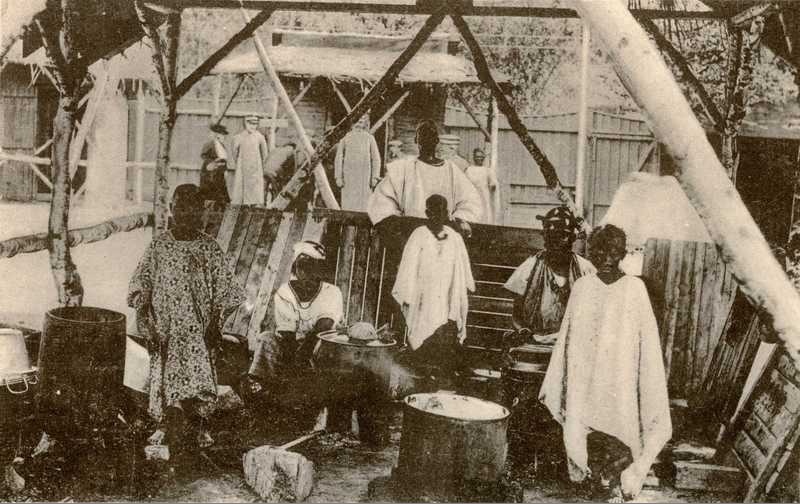
During European colonial expansion, Indigenous peoples were described as “monkeys,” “savages,” or biologically inferior. Black people were sometimes displayed in cages in Europe https://www.theguardian.com/world/2018/apr/16/belgium-comes-to-terms-with-human-zoos-of-its-colonial-past. Such language framed conquest as a civilizing mission rather than violent dispossession. Thinkers such as Aimé Césaire (1955/2000) and Frantz Fanon (1952/2008) argued that colonial systems depended on systematically denying the humanity of the colonized.

In the transatlantic slave trade, enslaved Africans were frequently depicted as animal‑like or naturally suited for bondage. Historian David Brion Davis (2006) documents how pro‑slavery theology and pseudo‑science worked together to rationalize exploitation. Orlando Patterson (1982) described slavery as “social death,” in which people were stripped of recognized personhood.

For people of faith, this colonial history demands humility. Scripture was often misused to justify systems that contradicted the biblical affirmation that all people are made in God’s image. Modern research shows the lingering effects of such imagery. Goff et al. (2008) found that implicit associations linking Black people with apes predicted greater acceptance of violence in simulated policing contexts. Dehumanizing metaphors do not fade harmlessly into history; they shape perceptions across generations.

Genocide and the Erosion of Moral Boundaries

The Holocaust offers one of the clearest examples of how dehumanization enables atrocity. Scholars such as David Livingstone Smith (2011) and Ervin Staub (1989) document how Nazi propaganda portrayed Jews as vermin or parasites. Anthropologist Alexander Hinton (2002) notes similar patterns across genocides: perpetrators first redefine victims as less than human. These patterns echo a biblical warning: when people are treated as objects or enemies rather than neighbors, violence escalates.

It is in this long history of dehumanization that we must view Donald Trump’s recent depiction of former President Barack Obama and his wife Michelle Obama’s heads on the bodies of apes in a jungle. This animalization mirrors earlier rhetoric in which he referred to immigrants as “vermin” or “animals.” Such language contributed to the justification of keeping immigrants in detention centers under horrendous conditions, because they were considered less than human and therefore undeserving of humane treatment.

Why This Matters for Faith Communities Today

Dehumanization rarely begins with violence; it begins with words, images, and small shifts in perception. Subtle forms—such as denying emotional depth to out‑groups (Leyens et al., 2000)—can gradually harden hearts. For communities shaped by faith, guarding language is not about political correctness; it is about spiritual integrity.

If every person reflects God’s image, then reducing anyone to an animal, a caricature, or a colonial stereotype contradicts that sacred truth. It erodes empathy, weakens the bonds of community, and dulls our responsiveness to suffering.

The consistent message across psychology, history, and theology is clear: seeing others as less than human makes injustice easier; seeing others as image‑bearers strengthens compassion and accountability.

In a polarized age, faith communities have an opportunity to model something different: speech rooted in dignity, disagreement without degradation, and conviction without contempt. To defend shared humanity is not only a social responsibility—it is an act of faithfulness to Scripture and to our calling as followers of Christ.


Picture credit: Africans exhibited at the 1914 Jubilee Exhibition in Christiania (Oslo), Norway, taken from : https://commons.wikimedia.org/wiki/File:Jubileumsutstillingen_1914_OB.F08939d.jpg

Selected Sources

Bandura, A. (1999). Moral disengagement in the perpetration of inhumanities. Personality and Social Psychology Review, 3(3), 193–209.
Césaire, A. (2000). Discourse on colonialism. Monthly Review Press. (Original work published 1955)
Davis, D. B. (2006). Inhuman bondage: The rise and fall of slavery in the New World. Oxford University Press.
Fanon, F. (2008). Black skin, white masks. Grove Press. (Original work published 1952)
Goff, P. A., Eberhardt, J. L., Williams, M. J., & Jackson, M. C. (2008). Not yet human. Journal of Personality and Social Psychology, 94(2), 292–306.
Haslam, N. (2006). Dehumanization: An integrative review. Personality and Social Psychology Review, 10(3), 252–264.
Hinton, A. L. (2002). Annihilating difference: The anthropology of genocide. University of California Press.
Kelman, H. C. (1973). Violence without moral restraint. Journal of Social Issues, 29(4), 25–61.
Kteily, N. S., & Bruneau, E. (2017). Backlash. Journal of Personality and Social Psychology, 112(4), 564–589.
Patterson, O. (1982). Slavery and social death. Harvard University Press.
Smith, D. L. (2011). Less than human. St. Martin’s Press.
Staub, E. (1989). The roots of evil. Cambridge University Press.

Leave a Comment

Mission in the Midst of Madness (Part 4)

Peace

Jesus Christ’s mission on this earth is the foundation of our mission today. One of the neglected aspects of Jesus’ mission is that of peacemaking and peacekeeping.  This aspect of his mission clearly shows us Jesus’ approach to violence and evil which was prevalent in his world as it is in our time. Social evils, bigotry, zealotry of all kinds including “terrorism” and “holy war,” banditry, class conflicts, foreign occupation, colonization, hostility between Jews and Romans, and Jews and Samaritans, fanaticism, and so on, were all present in the time of Jesus. He had to deal with them in the same way that we encounter these issues in our lives today. Jesus’ command to love and to work for the peacemaking was his response to the current events of violence and hatred in his day. He wanted to show both Jews and Romans that the peace that he has come to establish comes through love, acceptance of enemies, and unlimited forgiveness than revengeful violence or military might.

We have taken the Great Commission seriously and have crossed difficult geo-political and cultural boundaries in carrying the gospel to the ends of the earth. However, the church has often neglected the command of Jesus Christ to love our enemies and have failed to preach the good news of peace through Jesus Christ, which is an intrinsic aspect of Christian mission. If we fail in following Christ in this aspect, then we are guilty of neglecting his mission.

In the passion narrative of the gospels, Jesus refused to retaliate even in his self-defense. Jesus healed the servant of the high priest who was struck by one of his disciples fully knowing that the high priest had sent them to arrest and condemn him to death (Luke 22:50-51). At the cross, Jesus prays for his executioners (Luke 23:34). Stephen literally follows the example of his Master by praying for those who stoned him to death (Acts 7:60). Even after his resurrection and gaining a glorified body, Jesus does not go after the Jews who conspired to crucify him or the Romans who carried out his execution. If the history of the church narrated in the book of Acts of the Apostles shows us anything, it’s that although the fledgling church lived in the midst of hatred and violence, it made sure that peacemaking was an integral part of their missional existence in a world full of hatred. This struggling church was always on the move and outward looking in its mission. Their inner spiritual life of the followers of Jesus was always connected to and manifested in the outer world of sin and violence.

What was true of the Master must also be true of his followers today. We have no option but to make peacemaking and peacekeeping an integral part of our missional existence as a church of the Lord Jesus Christ. Jesus showed it and the world needs it!

Leave a Comment

Mission in the Midst of Madness (Part 3)

James_Tissot_The_First_Nail_525

Christian mission, which took birth in the violence inflicted upon Jesus Christ and his subsequent resurrection, has always had violence hover over it as Christians tried to obey the Great Commission of their Lord Jesus Christ. That is why I have often said that Christians should not be surprised by the violence we see around us. Mission cannot remain unscathed from the prevalent violence in the context of which mission is practiced. Nevertheless, violence also should not deter us from carrying out the mission God has called us to. As the gospel and well-established human assumptions and reflexes interact with each other it is bound to produce some sort of violence. That is why Jesus has given his Kingdom ethics to deal with the context of violence in which mission is practiced. Nothing summarized it more than the Sermon on the Mount (Matthew 5-7).

Particularly in the current context of violence and counter-violence, hate, domination, terrorism, and counter-terrorism, it has become imperative for the church on God’s mission to return to the ethics taught in the Sermon on the Mount. And to reflect upon it afresh and to confess that our failure to live according to the superlative demands of this ethics does not really absolve us from living the kingdom life here and now. The church does not have the liberty to exclude either violence or kingdom ethics from its missiological agenda even though it has tried to do so in the past. God’s mission has never been concerned with just the personal, spiritual, inner conversion of people’s lives; therefore, the church’s mission cannot be confined to only the spiritual conversion of human being and making their relationship right with God. So, the mission cannot stay apolitical because Jesus Christ and his sermon on the mount were certainly not apolitical because they challenged traditional structures and assumptions of every society. Jesus and his Sermon on the Mount challenge us to practice Christian mission beyond just “saving souls.” Our mission in today’s context must be political in the sense of peacekeeping, peace-making, working toward reconciliation and justice, dissuading people from seeking vengeance, and above all loving our enemy as Jesus exemplified in his life, deeds, and ultimately in his death upon the cross. Without this last act, Jesus’ Sermon on the Mount would have remained just a hollow sermon without any practical meaning for us. But we know that the Sermon on the Mount, in the words of Lapide P., “gets its true binding force only through the exemplary life, sufferings, and death of the Nazarene who sealed its validity with his own blood” (Sermon on the Mount: Utopia or Program for Action?, 1986: 141). May the Lord give us the grace and strength to take part in the mission that he began in his earthly life. Amen.

Leave a Comment

Mission in the Midst of Madness (Part 2)

https://www.youtube.com/watch?v=rylsA5_0jcM#t=116

Mission in the Midst of Madness (Part 2)

In my last post I pointed out that violence should not surprise us, as it does not surprise God who is familiar with it from the beginning. Today, I would like to share that Christian missions, too, was born in dreadful violence and calls us to diligently engage in God’s mission.

In the last days of his earthly ministry, Jesus was pursued by men who wanted to see him dead. At Passover, in his last journey to the Temple in Jerusalem, Jesus was so enraged by what he saw there that he got violent as he cleansed the temple. The spiritual and physical degradation of the people of God was at display in all its brazenness in the temple—“a house of prayer for all the nations”—turned into “a den of robbers” (Mark 11: 17). While Jesus’ startling behavior infuriated the religious leaders of the day, the common people responded by flocking to him. In Jesus, they saw a prophet who would restore the temple as “a house of prayer for all the nations” (Mark 11: 17-18). Jesus’ aggressive actions, however, also forced the Jewish leaders to act on their violent intentions against him that finally led to his execution at Calvary.

Jesus Christ suffered one of the most gruesome last hours on his journey to the cross at Calvary. Mel Gibson’s famous Hollywood film, The Passion of the Christ (2004), helps us understand some of that torture inflicted on Jesus and yet we will never fully fathom what a vicious death Jesus died for us.

It is in this violence, suffering, and his death on the cross, that Christian mission was born. Without the death and resurrection of Jesus Christ, we do not have any good news to share and no reason to call humanity to be restored and reconciled to God and to fellow human beings. Without the death of Jesus on the cross, there is no hope for the chaotic world. And this, I submit, is the greatest paradox of Christian mission: that God, in his sovereignty, would let Calvary become the fountain of our salvation, restoration, reconciliation, and eternal peace! Yes, I know, it is incomprehensible. Nevertheless, it is the Lord’s doing and it’s marvelous in our eyes.

Therefore, in the context of violence today, the followers of Jesus Christ who are also called to be witnesses of his death and resurrection, must take courage and strength from this paradox. We, who are his witnesses, should not be surprised by the violence and also should not shy away from sharing the good news. Let the violence around us not deter or overwhelm us from sharing and persuading people into restoration, salvation, and reconciliation. Let us persistently look unto God, the author and finisher of our salvation, and trust him to turn the violence and suffering into something beautiful for his Kingdom, because only God alone can do it. So, while it is easy to sing “I’ll cling to the old rugged cross” sitting in our comfortable pews of cathedrals, but very difficult to take the message of the cross to a violent and hurting world outside. However, the Great Commission of the One who died on the cross is not to sit and sing alone but to “go into all the world and proclaim the good news to the whole creation” (Mark 16: 15).

Leave a Comment

You have successfully subscribed to our blog. Thank you!

There was an error while trying to send your request. Please try again.

You agree to receive posts and updates from this site through the above email Id.