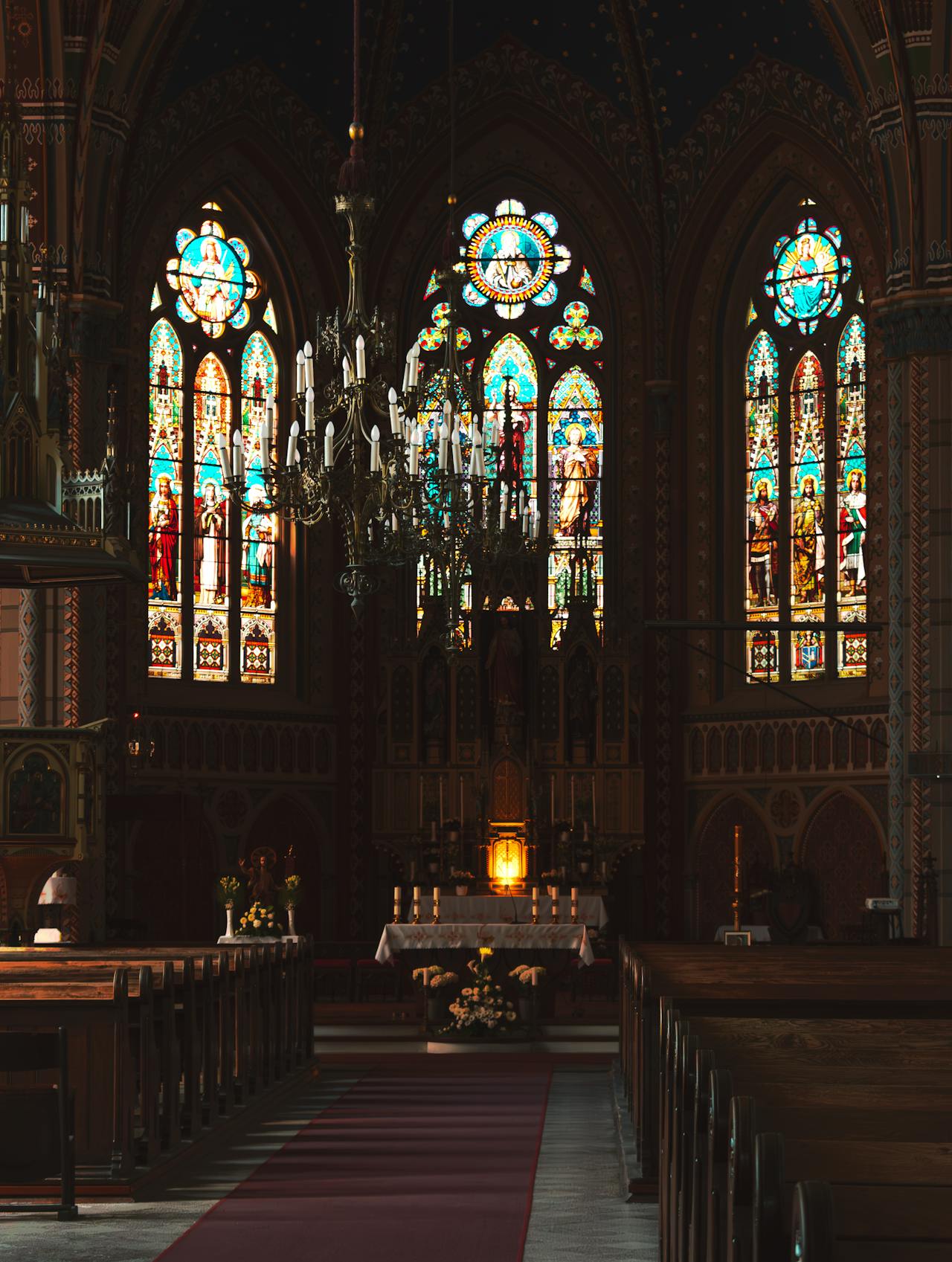
(Photo by Sándor Skoda from Pexels: https://www.pexels.com/photo/stunning-gothic-cathedral-interior-with-stained-glass-33419138/)
The word that keeps resurfacing as I reflect on the state of contemporary Christianity is shades. To me, it feels like a paint store with too many shades and not enough windows. Visit a few churches, browse denominational websites, or scan the congregations of any modern city, and the pattern becomes unmistakable. Christianity has splintered into hues — theological, liturgical, cultural, political, — that were originally meant to function as windows through which the light of Christ shines. Too often, however, those windows have hardened into opaque walls.
Many Christians have been trained to introduce themselves by their label first: Baptist. Anglican. Pentecostal. Reformed. Lutheran. Catholic. The label precedes the confession.
But what if that order is precisely the problem?
Baptism as a Transfer of Citizenship
Ask a Christian what happened at their baptism, and the answers frequently orbit around a local congregation, a pastor, or a denominational tradition. These answers are not entirely wrong — but they are incomplete in a way that matters enormously.
The Apostle Paul speaks of baptism in far more expansive terms:
“For as many of you as were baptized into Christ have put on Christ” (Galatians 3:27, ESV).
Baptism does not merely induct believers into an ecclesial structure. It unites them to a Person. And in being joined to Christ, believers are simultaneously joined to all who belong to Him — across time and place and every cultural expression of the faith.
Baptism is not a club membership. It is a transfer of citizenship. Emerging from the waters, the Christian does not join a franchise but enters a kingdom. We become part of the Corpus Christi, the Body of Christ, i.e., a communion that transcends geography, ethnicity, language, century, and skin tones. Baptism is less a membership card and more a passport into a reality far older and wider than any single tradition can contain.
The Problem of Tribal Christianity
Yet Christians rarely live as citizens of that kingdom. Too often, congregations and denominations become the entire horizon of Christian identity. Those outside one’s theological “shade” are treated not as fellow heirs of grace, but as strangers, rivals, or competitors for doctrinal legitimacy.
I’m not arguing against rootedness. Root matter as C.S. Lewis, in Mere Christianity, famously described Christianity as a great hall with many rooms branching from it. The hall represents the core of the faith, while the rooms symbolize the particular traditions in which believers worship, pray, and serve. Lewis rightly observed that one cannot permanently live in the hallway; one needs a room — a concrete community and a spiritual home.¹
Yet there is a profound difference between inhabiting a room and mistaking the room for the whole house. When denominational identity becomes primary, Christians confuse the filter for the light itself. The color of the stained glass begins to eclipse the sun shining through it.
What the Early Church Knew
The early church understood this with far greater clarity than many modern Christians do.
On his way to martyrdom in the early second century, Ignatius of Antioch wrote plainly:
“Wherever Jesus Christ is, there is the Catholic Church.”²
Ignatius was not speaking of a narrowly institutional structure in the modern sense. His concern was the universal presence of Christ among His people, a reality that could not be confined to a nation, a city, a bishop, an ethnicity, or a liturgical style.
Similarly, Cyril of Jerusalem instructed fourth-century catechumens that the term catholic meant “universal”— a church spread throughout the whole world, embracing every kind of person.³ Baptism united believers not merely to a local assembly, but to this worldwide communion of saints stretching backward and forward through time.
The early church inherited something immense and majestic. Over the centuries, that magnificent inheritance was too often reduced to brands, tribes, skin tones, style of worship, and competing subcultures.
Unity Without Relativism
Before anyone accuses this of being a warm bath of theological mush — let me be clear. This is not a call to believe anything, as long as we use the word ‘Jesus’ and smile at each other. The Body of Christ is held together by what the church has historically called the depositum fidei — the deposit of faith handed down from the apostles. The Trinity. The Incarnation. The atoning death and bodily resurrection of Jesus Christ. Salvation by grace through faith. These are not the “shades” Christians quarrel over; they are the white light that makes every legitimate shade possible. They constitute the grammar of Christian faith itself, and without them, the language becomes confusing. Church historian Jaroslav Pelikan captured it best:
“Tradition is the living faith of the dead; traditionalism is the dead faith of the living.”⁴
True catholicity preserves the apostolic faith with living hands. It allows the faith to breathe afresh in every generation rather than embalming it in rigid tribalism or denominational nostalgia. As St. Vincent of Lérins said, the test of genuine Christian unity is never doctrinal minimalism — it is fidelity to what has been believed everywhere, always, and by all.
Learning to See the Whole Body
Recovering this vision requires a fundamentally different posture toward fellow Christians.
It requires believers to stop guarding their shades and start recognizing the Body. When encountering a Christian from another tradition — a Coptic believer in Egypt, a Brazilian Pentecostal, a Benedictine monk, an Orthodox priest, a silent Quaker — the first instinct should not be to catalogue differences, but to recognize someone marked by the same baptism and claimed by the same Lord.
Such recognition requires real humility: the humility to learn from traditions one does not fully understand, and the courage to stand beside Christians who differ on secondary matters while remaining united in Christ.
In the words of Dietrich Bonhoeffer, “Christian community is not an ideal which we must realize; it is rather a reality created by God in Christ in which we may participate.”⁵
Christian community exists through Jesus Christ and in Jesus Christ. If He remains at the center, the church remains truly the Body. If He is displaced by our ideology, tribalism, or cultural preference, the community becomes something else, whatever Christian vocabulary it continues to use.
The Table Already Set
I keep coming back to the image of a table. Not a table divided by denominational seating charts — Baptists here, Catholics there, Pentecostals in the corner, Orthodox at another end — but a table where the decisive question is not denominational affiliation, but whether one bows before the crucified and risen Christ.
My baptism was not a ticket into a religious club. It was an invitation to that table — a feast already prepared and already populated by saints across centuries, languages, and traditions. The tragedy is how often Christians argue about the seating arrangements instead of rejoicing in the meal itself.
We were not baptized into a denomination. We were baptized into a Person.
His Body is larger, older, and more glorious than the imagination of any tradition. The cord that binds Christians together is not identical liturgy, shared political alignment, or uniformity on every secondary doctrine. It is the unbreakable confession that Jesus Christ is Lord — crucified, risen, reigning, and returning. That cord is strong enough. That cord has held martyrs and mystics, reformers and contemplatives, house churches in Asia and Iran and ancient liturgies in Ethiopia. It’ll hold us too, if we stop trying to braid something smaller over it.
Where have you seen the ‘white light’ shine through a different ‘stained glass’ window? Tell us below.
References
- Lewis, C.S. Mere Christianity. New York: HarperOne, 2001, Preface.
- Ignatius of Antioch. Letter to the Smyrnaeans 8:2.
- Cyril of Jerusalem. Catechetical Lectures XVIII.23.
- Pelikan, Jaroslav. The Vindication of Tradition. New Haven: Yale University Press, 1984.
- Bonhoeffer, Dietrich. Life Together. New York: Harper & Row, 1954.